Dogs Squabble. It Happens. People Make it Worse.
In this article I’m going to relay an event that occurred with my dog Rollo on the day of writing this. I think it presents a great teaching moment. The title of the article probably gives away what I’m going to start with, yes a squabble between two dogs.
I will first relay the event between the dogs and people, and then I will go into detail into why I did what I did and why I didn’t do some other things.
I was walking Rollo my intact male Tibetan Mastiff towards home, we were walking through a park, the particular path we were on was lined with trees and bushes so visibility of the grassy area for children to play is limited. As we progress down this path I see an off leash dog playing fetch with its owner, we are under 100 metres apart by this point, the off leash dog is a Rottweiler, turns out an intact male, 3 years old. Rollo, my dog is a month shy of 5.
The Rottie clocks us only a couple of seconds after we’ve noticed him. I see him make an immediate beeline for us, yes of course his owner attempts verbal intervention, which her dog duly ignores, there was something about his approach, the direct straight line I think, that set my alarm bells off and I decided to unclip Rollo’s leash. The initial meeting wasn’t the best, but nor the worst, there was a bit of growling as the dogs circled each other and tried to sniff each other. This isn’t unusual when dogs meet Rollo, he’s a big intimidating looking dog, but it is unusual from Rollo, he’s usually silent. After a few seconds dogs calm down when they realise Rollo does not mean them any harm. The Rottie and Rollo both marked a bush and this continued for 10 to 15 seconds as the other owner began to get close. This is where things start escalating.
The Rottie clearly doesn’t want the owner to catch him and put the leash on; he started playing what looked like musical chairs around Rollo with his owner chasing him. Rollo did fine, but I could tell he wasn’t enjoying this, especially as the other owner was clearly flustered and reaching around and over Rollo. As the owner ends this merry-go-round, and grabs her dog, her dog reacts and gets free and performs what I call the dominance mount on Rollo; the Rottie bites the fur at the back of the top of Rollo’s neck and mounts Rollo whilst snarling and growling. Rollo stands still but rumbles back at the Rottie, its a weird noise, its felt as much as it’s heard, its such a deep noise. At this point I tell the other owner to step back and not to try and grab her dog. I do likewise.
The Rottie gets off Rollo after 5 or 6 seconds and heads back toward its owner, Rollo follows him, which is not what I wanted, but Rollo is intent on making the point to the Rottie that a mount does not mean this interaction is over, and nor is the Rottie “dominant”. Once the Rottie arrives at its owner, who again starts trying to put the leash on, it notices Rollo has followed and gives Rollo a “f-off” snarl, which Rollo ignores as he tries to return the dominance mount on the Rottie, the Rotttie slips free before Rollo gets anywhere, by dashing around his owner, takes a couple of steps and turns, now the dogs are face to face, both rear up on their back legs and crash forward into each other. I’m sure you’ve seen dogs rear up and crash into each other in playfulness, this was like that but they weren’t playing. It was a more serious strength test. Here is Tora doing that rearing move playfully:
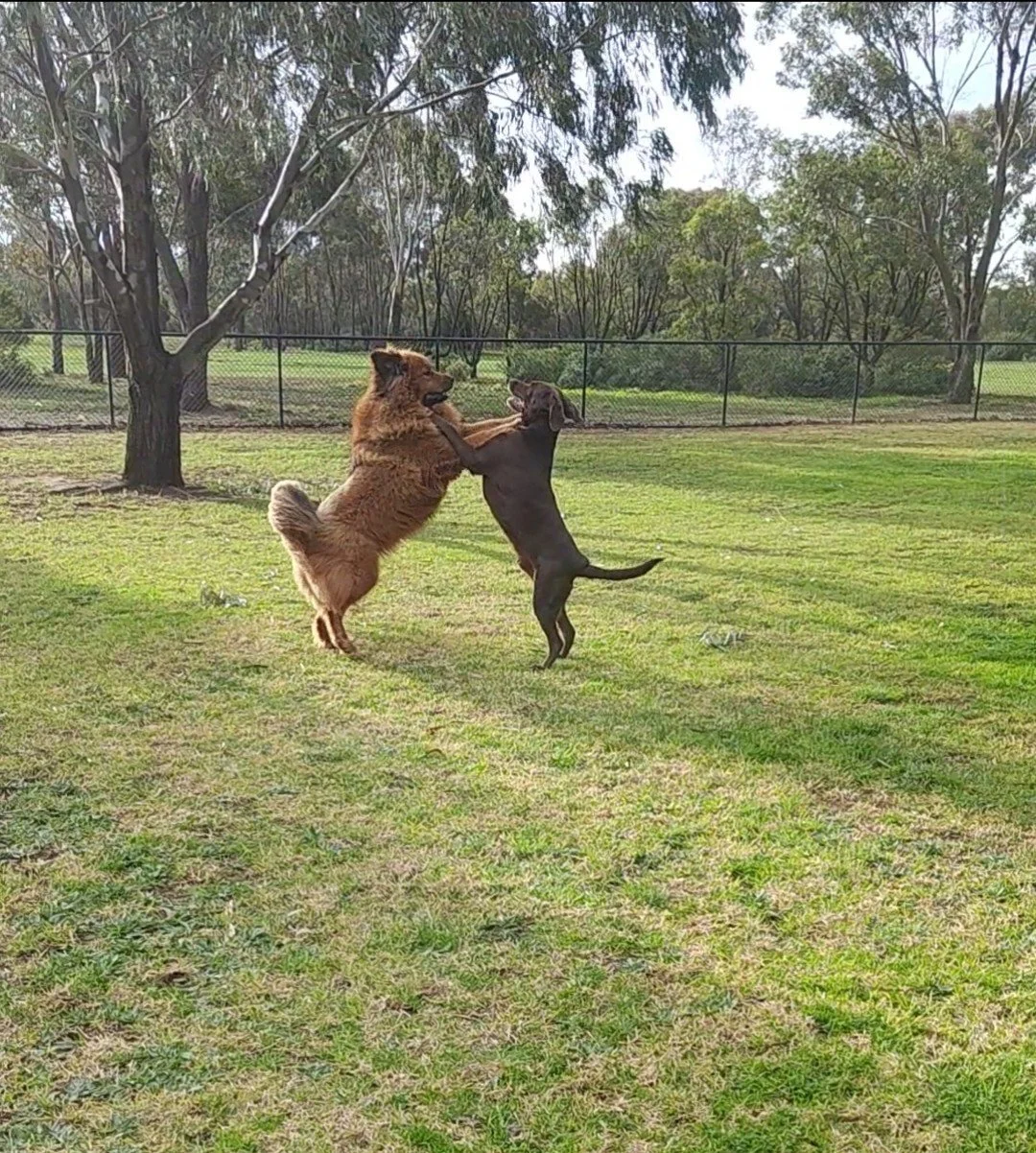
Tora and a Chocolate Labrador Rearing Up in Play
Rollo wins this interaction emphatically. In the manoeuvre Rollo forces the Rottie down, as he does this, he grabs the Rottie by and behind its right ear and forces the Rottie down into a fully prone lying on its side position, with Rollo standing over the Rottie. Rollo does not let go of the bite. There’s lots of snarling and growling at this point, Rollo is offering the chance for the Rottie to submit, he’s not escalating, he’s holding the position and making the point that he is the bigger stronger dog and he is in control of this interaction; Rollo is enforcing that dynamic and waiting for acceptance. During this I have again told the other owner to step back and not intervene, I have done likewise, again.
Rollo holds the Rottie down for somewhere around 10 seconds then lets him up. There is no blood and neither dog is hurt. The Rottie spends the next few minutes being annoying, circling Rollo, not really interacting but not leaving, he’s sniffing at Rollo and jumping out the way when Rollo tries to sniff him. For the most part we are back to Rollo standing still and the Rottie circling Rollo. The owner is repeatedly calling her dog, and he’s giving her a damn good ignoring.
The Rottie comes to me and sniffs me at one point, which was fine, I finally managed to get the interaction to end when I told the other owner to go out of sight at the other end of the park, then she called her dog and he went eventually, he went and came back twice before going properly.
Now you’re familiar with the event, I want to explain why I did not intervene between the dogs, and why I sent the other owner away too.
It’s worth noting that things only took a turn for the worse when the other dog’s owner got close. The relationship between the Rottie and its owner evidently played a large part in why things happened the way they did.
Why did I not intervene between the dogs? Firstly because this was not a fight. I am 100% certain of that. This was nothing more than two intact dogs doing handbags at dawn. Neither dog made any attempt at injuring the other dog when plenty of opportunity for doing so presented itself. There are many people out there who seem to think that any not entirely friendly dog on dog interactions are “attacks” and don’t recognise what they are seeing. Genuine dog attacks result in serious injuries that require stitches, staples and surgery, and in the worst cases, death. Dog’s coming out of an interaction with some slobber on them and fur slightly out of place with zero puncture wounds have not been attacked despite the loud noises and scary looking physicality of the interaction. The only thing wounded is pride in most cases. Sometimes the owners pride more than the dogs.
I have to ask quite a lot of searching questions with clients when I get the “my dog was attacked and is now reactive” line. Absolutely that happens and I’ve worked with dogs that have had to be stitched back together after a real fight. I’ve also shown people footage of nothing more than two dogs having a mild disagreement and been told that it was absolutely an attack, which it was not, not in a million years. The general public’s awareness of what constitutes an attack is very very poor, and that influences how I approach things with peoples dogs.
I am a great believer in dogs learning how to be dogs from other dogs. Take a wild guess how my Tibetan Mastiff, Rollo, learned how to approach dogs politely. He was on the wrong end of a few slap downs from other dogs when he was younger. He used to love running up to dogs and would sometimes put the brakes on too late and barge into them. He got corrected for those transgressions by the other dogs. He learnt those lessons far quicker that way than I could ever teach him. Why did this Rottie come at Rollo the way he did? Turns out the Rottie hasn’t met many dogs. A polite approach is not direct with dogs, there will always be a curve rather than a straight line if the intentions are friendly.
Nothing really kicked off until the other owner was in the mix and trying to grab her dog, that is what set it all off, so something about the mood of the owner and state of the relationship between her and her dog is off kilter, and that is what caused her dog to get physical.
Another reason I didn’t get involved is that I do not know how the Rottie would react to me trying to intervene, I could have made things worse, the Rottie was not wearing a collar so grabbing it would not have been simple, and given that Rollo may take that opportunity to get the upper hand which would escalate things, I decided the best option was to let the dogs work it out. This is not an easy thing to do, we tend to want to do something, even something stupid often seems like a good idea in the heat of the moment. Realistically my only option would be to grab both dogs by the scruffs of their necks, one in each hand and hold until the other owner could come get her dog. I’m a fairly fit and strong guy, but trying to do that with 110kg / 250 lbs of dogs is not an idea in which I fancy my chances of being able to pull off.
It is vital that people realise that the single most likely thing to turn a squabble into a fight is humans rushing in screeching, panicking and pulling at the dogs. All that extra energy and stress in an already highly strung physical altercation very quickly tips it over the edge into a full blown fight. Calm is king. In such a scenario, a calm authoritative demeanor will have far more impact in ending things than panicky shouting and rushing.
The most important bit of advice I can give to people when confronted with a scenario like this is first pause and breathe, then decide on a course of action. It doesn’t come naturally, but forcing yourself to do this brings your decision making back into the conscious part of your brain not the instinctive fight or flight part, which is where you automatically go when confronted with a scenario I’ve relayed here. Fight or flight decisions are usually rash and rushed and have suboptimal outcomes. Always pause and breathe, then decide and act.
Why did I tell the other owner to step back and out the way? I have seen enough of these encounters between dogs to know that, as I wrote a couple of paragraphs ago, the humans are the biggest reason things turn from not great to awful quickly, so my policy will always be keep the other owner away so their dog is not reacting due to the presence of their owner, there are so few of this type of situation where the presence of the owner is a good influence. The owner of the Rottie was actually fairly well aware that she was likely part of the problem today, she said as much to me whilst we were observing the dogs waiting for them to disengage. I fully trust Rollo to disengage as soon as practicable, he will do that, he has not desire to fight, but he won’t tolerate significant disrespect either.
The closest thing I have footage of that is similar enough to today is a Wheaten Terrier having a pop at Rollo. I perform the exact same actions in this video as I did today with the Rottie, I am trying to reduce the energy in the situation and trying to give the dogs space to work it out, which they do, and again nobody and no dog is hurt beyond wounded pride:
https://youtu.be/-hghdnfTITU?si=ZInrHMr2gIrykmcq
Of course there are limits and there is a time to get involved and stop dogs from doing each other harm. The difficult bit is recognising what is happening in front of you, and reacting to that appropriately. In the vast majority of cases, stepping back and doing nothing will result in the dogs disengaging and things returning to normal with only some ruffled feathers. Knowing your own dogs’ intentions is very valuable too, being able to rely on knowing that your dog will not harm unless harmed is a fantastic position to be in when things like this happen. I always carry a slip leash with me when out with my or clients’ dogs, because if I get to the stage where I truly have to intervene in a fight, I want the tools to hand.
The Wheaten Terrier learned a valuable lesson in the video, he got a few chances to deescalate, and thankfully he took one of those chances before Rollo was about to pin him. That dog would have learned far more from that interaction than if the owner had grabbed him and the interaction been over before it really began. Then it would have been potentially a far less patient dog than Rollo that it decided to pop off at, and the results could have been far worse.
I’m not sure that the same lesson applies to the Rottie as I cannot be sure of exactly why it decided to react to Rollo and mount him. The Wheaten Terrier was not under the influence of its owner, it was just scared. I cannot say the same definitively for the Rottie, it absolutely was under the influence of the owner, all I can say is that the presence of the owner was the cause, exactly what about the owner or what they were doing was the specific cause, I don’t know, and unfortunately that precludes me from being able to say whether the Rottie learned anything today. I hope so.
A misconception I’ve come across a few times is that the concept of stepping back and doing nothing will cause your dog to lose trust in you and become reactive. There is only one specific scenario where this holds true, and it is when your dog is leashed, is not the aggressor, and is the victim of an actual attack that you do not do anything to prevent. It is down to reading what is coming at you and intervening before it turns into something nasty. If this occurs off leash, it won’t be a loss of trust in you, it’ll be the operant learning that another dog did that to your dog. I shall anthropomorphise for a moment for clarity;
Imagine you are out with a group of friends somewhere and you get assaulted by a random person, a punch in the face lets say. You had a suspicion that something bad was going to happen, it did, you got punched in the face, but your friends just stood by and watched when you know full well they could have intervened and overpowered your attacker preventing you from being hurt, but they didn’t. You are going to lose trust in them.
Now repeat that scenario, but your friends are a distance away, you’re not actually fully aware of how far away. Could be a few metres, could be 50 metres. When you relocate them you realise that they were too far away to have been of assistance, you don’t lose trust in them. In both cases your trust in people you don’t know takes a hit, only in one scenario does your trust in your friends take a hit.
To return to dogs, they know when they are leashed. The leash is the arbiter of where the loss of trust will fall if an altercation turns truly nasty and you don’t intervene or prevent harm coming to them. Your dog knows if they are tied to you and cannot escape when leashed, if harm comes to them in that scenario, they will lose trust in you and become reactive. The leash will become part of the issue. There is nothing wrong with dropping the leash if you are unsure of another dog’s intentions, your dog will appreciate the gift of its own autonomy with respect to its self defence. It’s why in the Wheaten Terrier video I want leashes loose, we don’t want the leash associated with restrictions when the dogs are scared and we don’t want the leashes adding frustration into the mix either as that escalates the intensity of the reactions.
Either case presents challenges in getting your dog back to trusting dogs they don’t know, but don’t fall into the trap of thinking the trust in you automatically disappears or that by not intervening you are making your dog reactive because that’s just not the case.
I would like to finish by going on record and saying that I am immensely proud of Rollo and how he handled business. Always the minimum amount of force required to make the point and then he’s back to calm.