Aversive Tools as Communication Devices
What exactly do I mean with that title? The way E-collars, slip leashes and prong collars are sold to dog owners is that they are primarily methods of communicating with the dog. We can put the flat collar and leash into this category too, this combination certainly has the capability to be used aversively even though it is generally excluded from the aversive category. Allow me to make my point with some quotes:
“Think of a slip lead as a communication tool, not a choke chain. It’s like a gentle nudge that helps your dog understand “hey we’re a team, bud, follow my lead”. True Charlie Co.
“A slip lead isn’t meant to harm. It’s made to communicate and simple is better.” Will Atherton of Fenrir Canine Leaders.
“Using a slip leash isn’t about enforcing dominance or control, it’s about tuning in.” Be The Boss Dog Training.
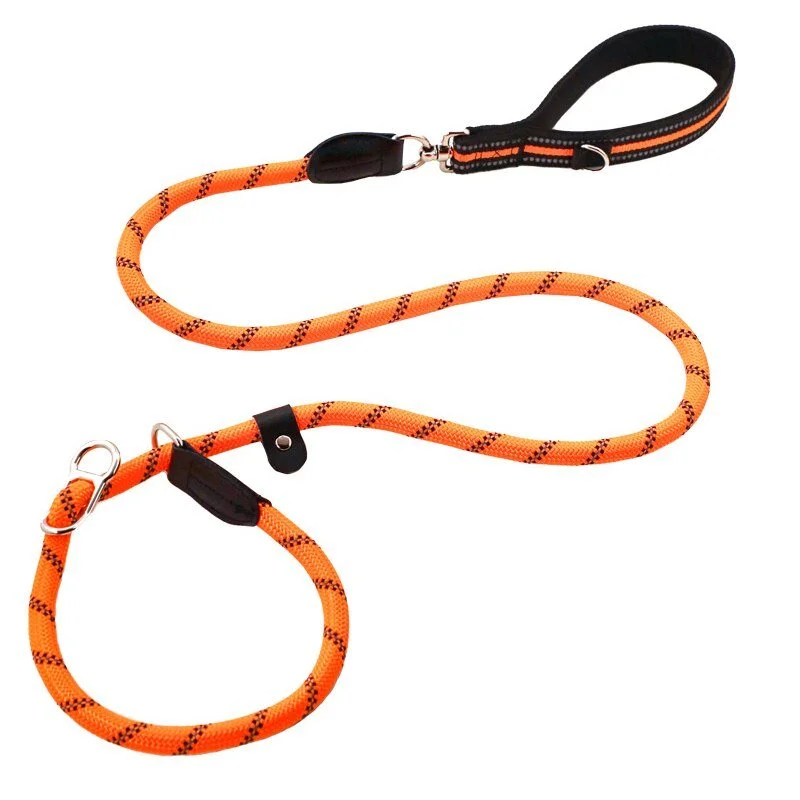
Slip Leash
“An E-Collar is a communication tool. It is important that we see the collar like the leash; as communication and not as a punishment.” The Naked Dog Training.
“Using an E-Collar should start with understanding, that it’s a communication tool, not a punishment device.” The Misunderstood Canine.
“E-collars offer a clear and consistent way to communicate with your dog, even from a distance.” Fetch Pet Training.

E-Collar
“Prong Collars enable you to deliver extremely gentle communication to direct your dog to follow you.” Dogology.ca
“Introduction to the prong collar with my Conversational Leash Work Dog Training Technique.” ConnectWithYourK9.
“There is a rich neural network throughout the neck, the prong is best suited to achieve communication through this network.” Nitro K-9.

Prong Collar
I think that presents a wide enough sample of the dog training industry to make the point that a large quantity of trainers see these tools as communication devices, and they are certainly popular around the world. As we all know, there are two sides to every story, and there is also a large quantity of dog trainers that see these tools as aversive punishment devices and are used to forcibly control dogs via some form of pain application. I also have to mention there are many places in the world where both E-collars and prong collars are outright illegal, I live in one such jurisdiction. So which side of the divide is correct and does it matter?
Not so fast…..first we need to define some terms: What is communication? What is punishment? The Cambridge dictionary has two related communication definitions and one punishment definition;
1) The process by which messages or information is sent from one place or person to another.
2) Communication is the exchange of information and the expression of feeling that can result in understanding.
Punishment:
1) To use or treat something badly, violently or without care.
2) [This B.F. Skinner’s About Behaviourism definition] “Punishment is designed to remove a behaviour from a repertoire. Punishing contingencies are the reverse of reinforcing.” This requires further explanation because Skinner goes on to say that “If punishment was simply the reverse of reinforcement, a great deal of behaviour could be explained” unfortunately punishment does not act as the reverse of reinforcement: “A punished person [or any mammal] remains inclined to behave in a punishable way, but punishment is avoided by doing something else instead, possibly nothing more than stubbornly doing nothing”.
Even having written that, the punishment side of things is out of context and needs some explanation. What it means is that punishment for doing a behaviour does not make a repeat of the behaviour any less likely, once the punishment and threat of punishment are stopped and removed, which is different to reinforcement. The technicalities of Punishment can only be fully understood once the behavioural concepts of reinforcement are understood. To get a solid understanding of that concept, you’ll need to read these:
What Is Operant Conditioning? — Partners in Canine by Pete Wreford
and
How Does Operant Conditioning Work? — Partners in Canine by Pete Wreford
So how do the tools work? We need to understand their mechanisms before we can pronounce any judgement on them or how they are intended to be and actually are, used. We’ll start with the slip leash, though choke chains and Martingale’s pretty much fit here too.
The slip leash works by tightening around the neck when pressure is applied by the dog or handler. The physiological effect is between restricting both the air supply to the lungs and the blood supply to the brain all the way up to inducing unconsciousness by actually cutting off the blood supply to the brain, the air supply is also heavily restricted, but not entirely cut off, this leans more toward pain than unconsciousness, the blood supply being cut off is the chief mechanism. I shall call those mechanisms by their commonly known names; blood choking and strangulation. The correct placement of the slip leash is as high up the neck as possible where the blood supply and trachea are most exposed. The intent is to make the behaviour being attempted too painful to continue, or the threat of the pain too much to bother trying to do the behaviour at all. The choice offered to the wearer, the dog, is comply with the leash pressure or be strangled, potentially to unconsciousness - you know, just a bit of gentle communication with the threat of unconsciousness to it. I treat my loved ones like that all the time……
Onto the E-Collar:
There are multiple variations of the E-collar, some have more intense functions than others, this is how they work: E-collars work by delivering stimuli such as audible tones, vibrations, or static electricity pulses to a dog’s neck. Combinations of the stimuli are also possible. The audible tone is self explanatory, the other functions of the e-collar work by stimulating the dog’s nervous system around the neck where it is extremely sensitive.
I have found a couple of trainers trying to sell me a difference between a shock collar and an e-collar - having read their explanations; '“one is for positive reinforcement, one is for punishment”, I am shocked (pun intended) that people can keep a straight face in saying things so obviously false. Such a statement, made by multiple trainers, is so far removed from the reality of behavioural science that I’m not even entertaining that as a serious point of view, and neither should you. It reveals a complete ignorance of what reinforcement and punishment are and how they work, I digress;
The e-collar mechanisms range from an unpleasant experience at low levels of intensity, all the way up to shocks strong enough to cause all 4 paws to come off the floor simultaneously, combined with physical burns and long term psychological damage including anxiety, fear, depression and distrust in the owner. The intent of the e-collar is generally to interrupt a behaviour, or prevent a behaviour from occurring by applying the unpleasant or painful experience to the neck, however, in use for recall, the unpleasant experience is turned on until the dog returns to the owner. It is a curious notion that people find themselves in such a predicament with their dogs that they have to punish them to, and until, they come back to them. I don’t consider that a good basis for a relationship. In general the E-collar is intended to serve as a “tap on the shoulder” to let the dog know that the owner doesn’t want the dog doing whatever it is doing. It doesn’t quite work like that, as I’ll explain later.
Unlike slip leashes and prong collars, E-collars can be used across considerable distances which is why they are so popular.
The prong collar
The collar works through pressure applied by the prongs into the neck. This is intended to be uncomfortable but not painful (Really? They expect me to believe this?), encouraging the dog to stop pulling and walk calmly beside the handler. This [allegedly] mimics the natural behavior of a mother dog correcting her puppies by nipping at their necks. Prong collars have been known to damage the trachea and thyroid as well as have a longer term negative psychological impact. The intent of the prong is the same as the slip leash, to interrupt or prevent a behaviour, and the mechanism by which it works is discomfort and pain. Yes, pain. Of course it’s painful, dogs are quite capable of ignoring discomfort when going about their lives.
There is a common thread running through each of the tools I’ve listed in this article. Each one of them is designed primarily to prevent or interrupt a behaviour, through either the threat of, or application of, an uncomfortable and / or painful experience. What is also common is that advocates of the tools always downplay the intensity of the pain when applied.
If you’ve read my links to Operant Conditioning, or you’ve read some B.F. Skinner yourself, you’ll know that interrupting or preventing a behaviour is punishment. It therefore follows that each of the tools listed are punishment devices, this is the technical truth of the matter. For fairness, the standard flat collar and leash can also be thrown into the mix here, that can also be used as punishment, there is no denying that.
Does that mean the devices are not, as is being touted, communication devices, rather they are punishment tools, or as some call them, aversive tools, or is it the way you use them?
There are two distinct streams to it; 1) The technicalities of punishment in terms of does it actually work to change behaviour and 2) The moral or ethical internalised thought process that determines what each individual thinks is right or wrong in terms of punishment. Let’s tackle the technicality first because it’s easier.
Do slips, e-collars and prongs work? It depends on your definition of work. They are very successful at interrupting behaviour, and very successful at stopping it from even starting in many contexts. The problem arises when we realise that in order for them to work long term, they have to be ever present, i.e. if you rely on the tools to control or modify behaviour, the dog will never not wear those tools. On this the science is explicitly clear; a punishing contingency does not alter the desire to perform a behaviour, it cannot and does not change the mind; as soon as the dog realises that the threat of punishment is no longer present, the original behaviour will return. You can test this with any dog that is currently under the control of a slip, e-collar or prong. If you swap for a flat collar and leash and go and find a trigger, you will see the original behaviour return. E-collars sometimes take a little while to register as missing, prongs and slips the return will be instantaneous. So in terms of a training tool to change behaviour and then be retired from use, no, they don’t work, they need to be applied for life.
Onto the ethics discussion. Perhaps these tools can start off as a method of communication, but this is such broad term as to be meaningless. What level of pain within communication is justified? Good question. How much pain do you apply to your friends and family in your communication with them? I mostly don’t strangle and shock my friends and family. I don’t think I would be respected much if I did, feared, yes, respected, no.
The point of the communication using these tools is to get the dog to understand “don’t do that”, the old “tap on the shoulder” thing. Unfortunately, Prof Skinner looked into this too, and he had some interesting results; the use of punishment creates a vicious cycle whereby the punisher will continuously increase the intensity of the punishment to obtain the same results. This is because punishment cannot change intent, so the tolerance for the punishment increases as the animal or person continues to try and do the behaviour, thus the intensity of the punishment must also increase.
As with lots of things, what starts out with good intentions falls foul of reality; punishment cannot change intent, the punishment will have to increase over time to get the same result, and the punisher will willingly increase the intensity of the punishment, just as Skinner proved, we can’t help ourselves, and all the while the relationship between owner and dog deteriorates.
Therefore, to state that tools such as e-collars, slips and prongs are tools of communication is misleading, the intent of them as communication is the starting point on a journey that will take you all the way to maximum pain if you stay with the tool and do not address the underlying cause of the behaviour. The industry at large is operating in denial of this principle discovered by Skinner.
I know a trainer who ended up double e-collaring their dog, rather proving Skinner’s research translates to the real world. If you think you are a better person than that and wouldn’t fall into this trap, good luck to you, you can be the exception that proves the rule.
In terms of the tools I’ve looked at here, the design of each of them is such that it allows owners and trainers to do things with dogs without having to go through the trouble of addressing the underlying causes of the unwanted behaviours, there’s no need when you have a tool that just shuts down the behaviour instead. This is a shortcut to a place that doesn’t really exist. The dog will look good, but in reality, the moment the tools are gone, you’re in trouble; you have a misbehaving dog, you don’t know why, and the dog doesn’t respect you. That’s not winning. Let’s look at an example;

Dog in a prong collar
As the caption says, this dog is wearing a prong collar, I’ll post another picture showing it clearly. The dog is being forcibly dragged away from a bowl of food. Why a prong collar? It’s the only way the dog can be made to comply, though a slip leash would work equally well. Is this really communication? A tap on the shoulder? No, the tool is being deployed to and is forcing compliance through pain. This is occurring because the dog has no idea who this guy is, and has a bowl of food placed in front of it, which it wants.
This is my point in action, there is no relationship between the dog and human, thus the dog has no reason to comply, so it’s trying to do what it wants, eat the food and the human is having to employ a lot of pain to force compliance. This isn’t training anything except pain aversion and probably stranger aggression. You can set this scenario up between any random person and any random mammal and you will have to resort to force and pain to obtain compliance. This is because what matters is the relationship between the parties. Don’t have a relationship based on mutual trust and respect? You won’t ever get voluntary compliance without the threat of punishment. It’s staggering that something so basic is lost on so many people.
The solution to the issue above can be found here; Resource Guarding Part 1 — Partners in Canine by Pete Wreford.

View of the prong collar
As far as the concept of a relationship with a dog based on mutual trust and respect mixes with these tools, I find the expression “you can’t get there from here” applies. What do I mean? In order to get to a place that can be described as having a relationship based on mutual trust and respect with Man’s Best Friend, which by the way, should be your goal, I find myself looking at these tools and thinking how on earth could any animal respect and trust the human that puts these tools on the dog and uses them to suppress behaviour? The same question applies to the human, how can any human that respects and trusts their dog put these tools on their dog and expect trust and respect in return? The honest answer for the dog is they can’t and they won’t, for the human it is they don’t. You can’t get to a relationship based on mutual trust and respect if you think the route to it involves these tools. It really is as simple as you can’t get there from here. If you wish to test that, ask your spouse or best friend to wear the devices when around you and see how it goes.
I absolutely acknowledge that we do need to communicate with our dogs, same as we do with fellow people. There are rules, boundaries and expectations, there are many things our dogs want to do that we don’t want them to do. The best way to reach through to our dogs is to lead, and lead by example. Punishment is the least effective way of communicating with our dogs. Restraint from something with a flat collar and leash is as punishing as I need to ever get. Dogs are so far ahead of us in terms of reading us and our meaning that we are like an open book to them, the problem is we get stuck on transmit and don’t listen to our dogs.
We don’t need to hurt them for them to understand what we want. We don't need to manipulate them with “taps on the shoulder” and label it communication either. We need to foster a better relationship with them, listen to and accommodate their needs and wants, and be someone worthy of their trust and respect. Once you’ve got that, then being with us and pleasing us becomes their number one priority. A dog that truly trusts and respects you, won’t do the things we are told we need slip leashes, E-collars and prong collars for. Get that relationship to the right place and all the tools become redundant, that is why I talk about relationship so strongly, it is the foundation on which the solution to all the behavioural issues is built.