Muzzles are a Breach of Trust
Well with that title there’s little room for doubt on my stance on muzzles. So I may as well get the headline argument laid out right away;
Muzzles are a breach of trust, and they also provide means for the humans to continually breach the trust of the dog without having to worry about the physical consequences of the dog having a differing opinion on what is being done to it, or what it is being made to do. It is, if we distil it down as far as possible, the human desire to impose authority and control in determining outcomes, irrespective of the free will of an intelligent sentient being and the damage to trust done in the process.
How are muzzles a breach of trust? Dogs use their mouth in normal communication with the world around them, it also serves as the primary defence mechanism, should the dog need it. By preventing the use of the mouth we are taking away that communication and defence mechanism, and the dog knows it. Let me get technical for a minute; in behavioural terms, we are taking away the dog’s ability to remove a negative reinforcement from the environment, which is the same as preventing the dog from obtaining positive reinforcement - behaviourally the removal of a negative reinforcement is a positive reinforcement, Skinner 101.
If we anthropomorphise the para above, imagine your friend is a really good boxer or fighter and you’re going out for dinner and a few drinks. You are concerned that your friend might do something bad if someone gets in their face, so just in case, you insist that they have their hands tied behind their back for the evening. Exactly how much are they going to like that and exactly what are they going to think your opinion of them is? Do you think the words “trust me” will reassure or ring rather hollow? Oh it gets worse. Now in the restaurant you bring out something they are scared of, or instead, you start getting people to come up and touch them, maybe cut their nails, you don’t need their permission, you have decided they need to experience this without being able to hurt anybody until they get used to it. Tell me, how long will your friendship last? How much trust and respect have you gained? How much less traumatic will repeating this scenario get each time? This is what you are doing to your dog when you muzzle them. And they know it.
One thing a dog wearing a muzzle tells me above all, is that the owner does not trust their dog. It is almost impossible for the dog to trust the human in such a situation. I have never come across a dog that is muzzle trained that does trust their owner. How do I work that out? There is always a behaviour problem. Always.
Muzzles are a popular tool for dog trainers, owners and vets. If you belong to any kind of dog group on social media you will have come across people advocating for them, people using them and people asking about how to fit them to their dog. Pretty much every dog trainer I’ve ever interacted with is pro muzzle, right across the spectrum from Balanced to Force Free.
Why are muzzles so popular? Like I said above, they eliminate the risk of serious injury or death to the handler or other animal from making a dog do something or be subjected to something that it really doesn’t want to do or be subjected to. This is a big problem in terms of the relationship owners and handlers have with dogs. The highest goal of all dog owners is a relationship based on mutual trust and respect. Control without (physical) consequence is a poor substitute for this relationship, and it always comes with behavioural problems.
A relationship based on mutual trust and respect is a two-way thing that not only takes into account and allows for our dogs to have opinions about what happens to them, but for them to express those opinions to us with the expectation of being listened to. If you want your dog to respect you, first, you need to respect your dog, and putting a muzzle on them is the reverse of that.
The first counterpoint I usually get when I tell people what you’ve just read is “what about situations like introducing adult dogs to kittens? We don’t want the kitten to get hurt.” Nobody wants the kittens to get hurt. The issue is deeper than what is being presented in the question. The issue is always first and foremost that the owner is admitting that they don’t trust their dog (if they did they wouldn’t need a muzzle) and they are admitting to being unable to read the dogs signals of discomfort, or they don’t care about those signs, and they are admitting that they do not know how to influence their dog’s behaviour beyond physical control, essentially their dog has no respect for them and does not mirror their moods. Worst of all, and I’ve seen this, they’ve decided to get a cat without any forethought on whether that is a good idea because of the dog. I have introduced my Tibetan Mastiff’s to neighbourhood cats, no muzzle required. To be fair, most cats are not at all interested, which is fine, but a couple that live with dogs have allowed my dogs to meet them.
It’s not the best picture, but here is the first cat that allowed Rollo to approach. They are friends, and can make physical contact with each other without issue. All done without a muzzle, and both animals always have the option to refuse the interaction at any point.
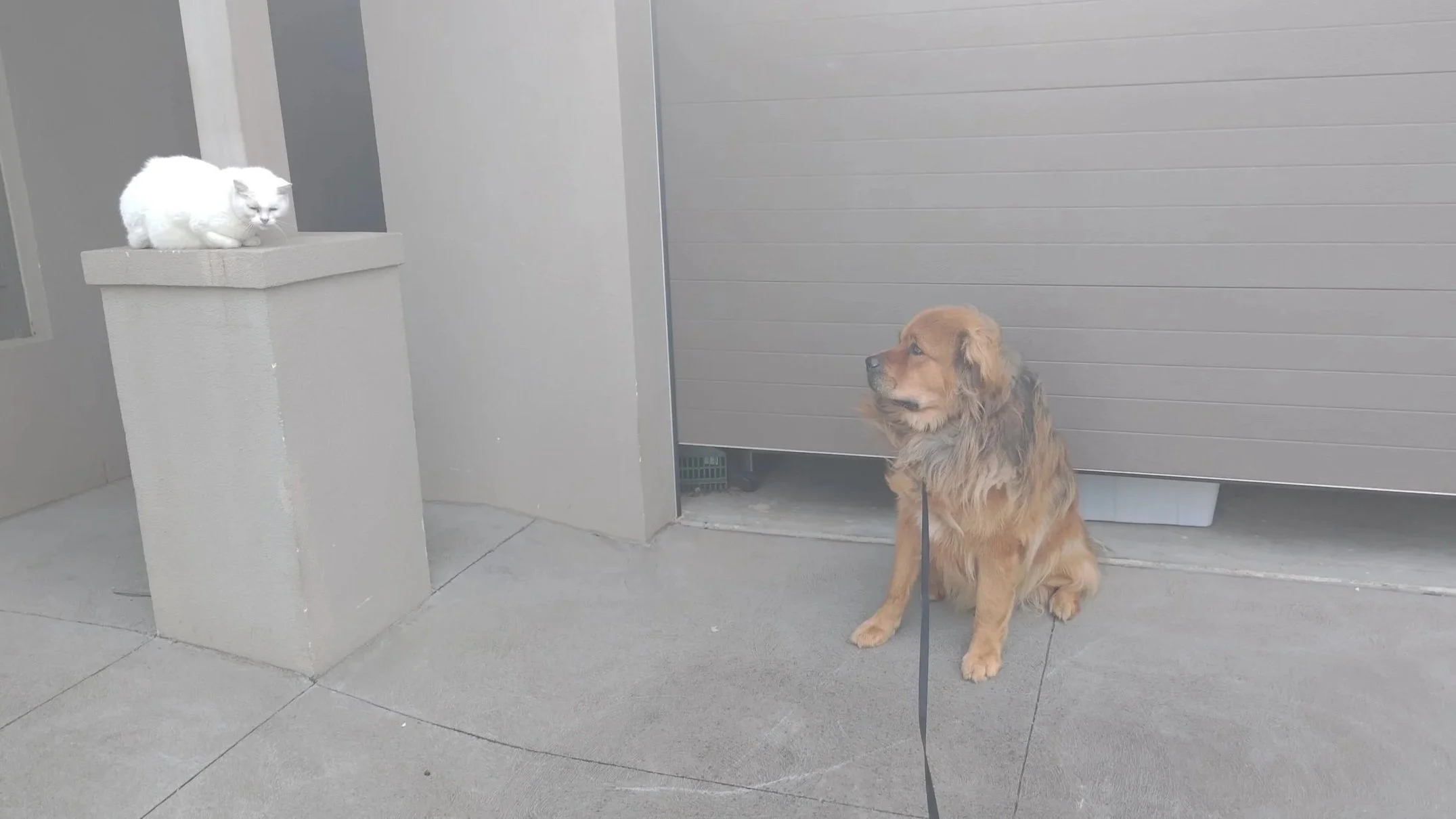
Rollo, the dog, and Snowy, the cat.
The second counterpoint I get with this subject is what about when unleashed dogs run up on your dog? Well, I hate to break to people, but that means there’s work to do with your dog. Off leash dogs running up on your dog should not equal an immediate bite or fight risk. Yes there are dogs that do bite first and ask questions later, and I work with those aiming to get them past that problem, which is one usually borne of fear due to lack of socialisation and social skills. Fix the actual cause, and the problem behaviour extinguishes naturally.
The other point worth noting, and I have sadly met someone whose dog fell victim to this, is what if your dog is muzzled and another dog runs up who actually has bad intentions from the start? Your dog is now totally defenceless except for you, because you were worried about what your dog might do. It’s a rare scenario, but a quick scroll on social media or dog attack statistics should be enough to at least make you think twice.
I have had to muzzle Rollo; at the vet for his last blood test one of the vet nurses didn’t like the size of him and the way he looked at her when she came and sat by him, so they asked me to muzzle him. They didn’t really leave me much choice, so I did. Rollo isn’t muzzle trained. He does trust me though. He just sat there and let me put it on, with a little help from another vet tech. Not a peep out of him, not even when drawing the blood. Sigh. I do understand the vet tech’s position though, they’ve undoubtedly been on the wrong end of teeth doing this procedure. Like I said, dogs have an opinion about what happens to them, and it is foolhardy and destructive to our relationship with them to ignore what they are telling us. Once you have the full trust of your dog, that is the point at which they will let you put a muzzle on them without any prior training, ironically, it is also the point that you won’t need the muzzle ever again. Relationship is everything.
Muzzles give humans power. We’ve fallen into the trap of thinking that this power gives us moral permission to ignore the dog’s nature and divorce ourselves from physical consequences because we need a specific outcome. We can correct that state by building a relationship with our dogs based on mutual trust and respect, with two-way communication. All the things currently running through your head that you can see the utility of a muzzle for are rendered easy and stress free when your dog truly respects and trusts you - that is the goal above all else.
For full disclosure and honesty, with my first client, an AmStaff, I did use a muzzle, the videos are still on my YouTube, but that was when I was using the balanced dog training system. That dog was also subjected to a slip leash. I have in my time working with dogs and owning dogs, gone very public and strongly disavowed aversive tools, and balanced dog training. I’ve written about that at length in other articles. Don’t be fooled into thinking that that means I have gone over into the Force Free crowd, I disavow that system equally with Balanced Training. Eh? So what system do I use? It isn’t a system, I’ll leave it at this in this article; I train people on how to achieve a relationship with their dog based on mutual trust and respect, when this is truly reached, most behavioural problems disappear all on their own. My work with clients’ dogs is purely based on understanding the cause of problem behaviours and fixing those problem behaviours through both socialisation and interaction with my helper dogs i.e. my dogs are better teachers of dogs than I will ever be.