Stop Talking to Your Dog
The levels at which communication operates with the human to dog relationship are deeper and broader than we realise. I am often found telling people to stop talking to their dogs because talking confuses the message.
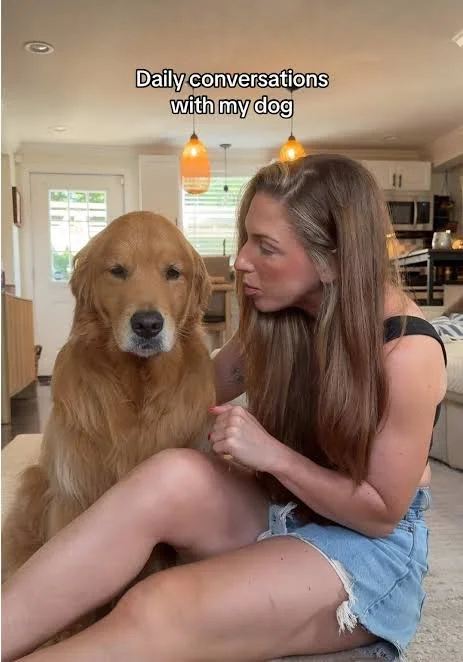
Yeah, maybe just stop talking is a broader message than I first thought
I have come across a few people in my time who have been very much wedded to the idea of talking to their dogs because dogs not only understand our tone, but also our words. In effect dogs almost understand language, it’s not as sophisticated as humans, they can process some words and variations in intonation. This has been demonstrably repeated in multiple laboratories using neuroimaging (MRI scans). However, talking to your dog does not help overcome reactivity or aggression issues.
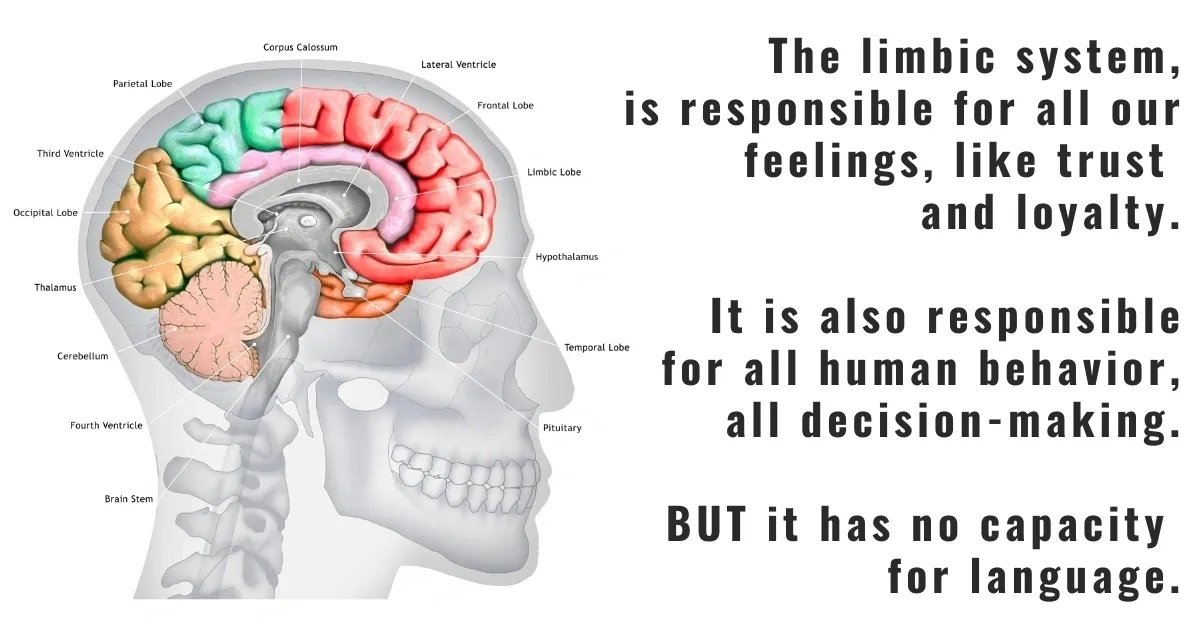
Language processing is a cognitive function; it requires the conscious part of the brain to build intent and meaning, form words, speak words and on the receiving end, hear and interpret meaning. When we are dealing with reactivity and aggression we are not dealing with a dog that is operating on the cognitive level. They are operating on the instinctive limbic level i.e. fight or flight.
In fight or flight the cognitive processes are almost entirely shut down because the brain is focussed on either removing the threat or moving away from the threat, that is, getting back to feeling safe. Only when that feeling of safety has returned does the cognitive function return to the brain. It’s also worth remembering that the limbic system has zero capacity for language. Nothing, nada, zilch. Cannot do. So little to no cognitive function and no capacity to comprehend language when in fight or flight……a bit of problem for a scared dog being talked at isn’t it? So stop talking.
Variations of this have been shown in humans too; when humans are stressed, our IQ points noticeably degrade. The more acute the stress, the larger the reduction in IQ. That’s because IQ is largely a cognitive function i.e. conscious thought. Stress pushes us towards a more limbic existence in the moment, clouding our problem solving abilities. It’s why The Crystal Maze was a fun television show. We watched people struggle with team and self-imposed stress and knowing they are being filmed for TV (whatever sort of stress that is) trying to overcome problems whilst we would be shouting “you idiot” at the TV because we could easily see the solution from our sofas. Stress reduces your cognitive ability. Who always performed the best? The person who could withdraw from, or, rise above the stress.
Side quest: How do we name emotions if the limbic system, where they come from doesn’t do language? This is a complex issue and I’m going to criminally oversimplify it, but essentially your cognitive conscious brain has an ability to “read” the chemical mix the limbic system is putting out based on the external environment being sensed and processed (remembering something also counts as an external environment for how this works, long story) and to label that specific chemical signal (full spectrum across all the emitted brain chemicals) as an emotion with a name. It’s repeatable which helps. Clever little things, brains.
Back to dogs. Sort of. Humans are notoriously bad at matching internal states with external delivery. We might say one thing in an excited happy way, but if our mind is racing with anxiety, tension, home life problems, our autonomic nervous system will be leaking small signals of those stresses that contradict our words. To the dog, who can pick up both sets of signals, this is confusing. To the dog, the primary reading of you is from your autonomic nervous system;
Dogs are savant-level observers of physiological states. They regulate their emotional baseline largely by reading the energy and nervous system state of those around them, we call that process co-regulation, and yes it crosses species boundaries. There’s a bunch of scientific papers on this; I’ve posted a couple on my FB page before. One other strand to consider is that the dog’s ability to perceive us through our autonomic nervous system being as good as it is, means we cannot lie to them. We cannot fake what we are feeling inside. The adopting of a “mask” we show other people in the outside world is a pointless charade to a dog. They see right through it.
The state we want to present to our dogs is one of true calm. Calm but also present in the moment with them. The most effective way to achieve this is to shut off your conscious brain, stop all thoughts. No that’s not easy. Not at all. It takes much practice. You won’t be far wrong if you see many similarities to meditation, yes that state, get like that. This will bring true physiological calm and that will mean all the human stressful baggage every one of us has will get put back into the box and not be projected onto the signals we are giving off to the dog.
Now try and do that when your dog is being reactive. Yeah I know, super difficult. But necessary. This calm state is what pulls the dog towards you when its in a state of fight or flight. You are offering the most attractive thing there is; a true sense of calm among chaos. Calm that slowly gets attention, but its attention that requires no interpretation. The dog’s limbic system detects you in that state without needing the conscious cognitive functions, that is the big advantage silent presence has over talking; there is no decoding required. Its subliminal attraction at the most base level.
This is particularly important for overcoming reactivity because reactivity is a fight or flight response. I know its upsetting to read it, but that reactivity is a trust problem. Your dog does not feel safe in that situation with you, thus the fireworks. I want your dog to feel safe in your presence, even in the face of potentially grave danger, and that only comes when you exhibit calmness from your autonomic nervous system, because that is the antidote to the dog’s stress. This is how foundational trust is built in the relationship.
Once you’ve got the foundation in place with deep trust from your dog, you can start talking to your dog. Relationships have layers. Trust is the foundation, once you have that, you’re ready to go to the next level, and now you can start talking.