The Concept of Clarity
The concept of clarity in dog training is an interesting one. Everyone agrees that our dogs need clarity in their expectations of how to behave, including me. How that is achieved is the important bit, because what I shall reveal is that some methods do not attain the goal of environmental clarity; they merely clarify what the owner or handler dislikes.
There are going to be many similarities in this discussion with the concept of using aversive tools as communication devices (https://www.partners-in-canine.com/blogs/communicating-with-your-dog-using-tools/). The short summary of that argument is that if a prong collar, e-collar or slip leash are communication devices to our dogs, me punching you in the face is also a communication device and you should behave as I expect in my presence because of the ever-present threat of that outcome. It works only when that threat is ever-present. When it’s not there, the original behaviour always returns. Ultimately, it’s a nonsense argument that totally fails to understand that any form of physical compulsion cannot change the desire of the dog to do the behaviour, and on top of that it is the beginning of the slippery slope into ever harsher punishments and relationship destruction, which has been repeatedly proven to be what happens when you give people total authority.
I think it worth a brief mention of the exception that proves the rule here; if you zap a dog hard enough just once for a specific issue, the likelihood is that the behaviour won’t return for years, if at all. There are a couple of e-collar clinical studies tracking predatory chase suppression out there proving this, the scenario involved in both the 2001 & 2004 studies was chasing sheep. One un-trained max power zap of the e-collar resulted in an almost 100% success rate for years. Do not underestimate the strength of that zap though. Critically it still doesn’t break the iron law of punishment – the desire to do the behaviour did not change, but the threat of the zap overrode it. I shall assume something similar exists for the other tools, but I have not read studies explicitly stating this.
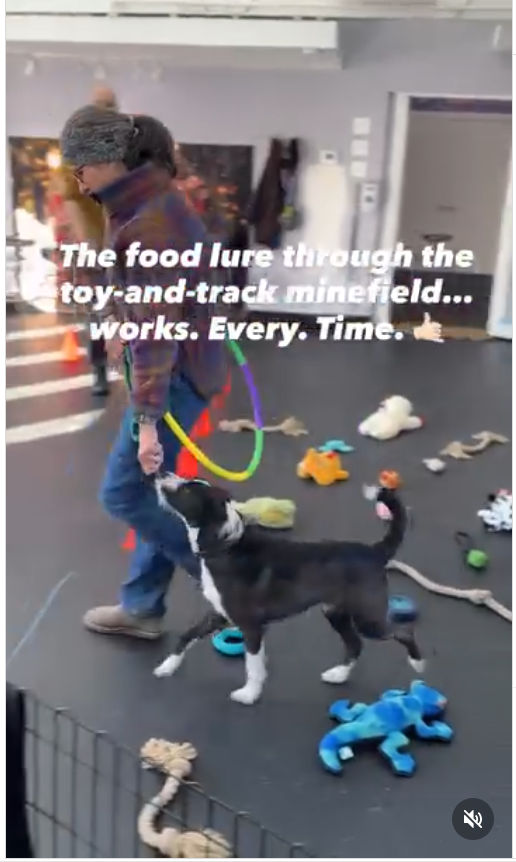
Seeking an alternative to the threat and application of force, the Force Free (FF) crowd insist that their method provides true clarity in expectations for the dog, and in easy environmental settings this is true. The way this is achieved is through extreme antecedent (think environmental) manipulation and errorless learning protocols with “reinforcements” for completing the micro steps then chaining them together to form the wanted behaviours.
I have a few fairly strong criticisms here;
Since when did learning need to be errorless? What gibberish is this? Why has the concept of trial and error or learning through our mistakes been done away with? That is a really backwards development and I would wager harmful to the development of internal thought processes and learning as well as to the bonding process with the human.
Secondly, the real world is not so easily controlled and when something unexpected comes out of leftfield the dog has nothing to lean on in terms of being able to become indifferent to the new thing, because it never learned how to. Having your every micro step managed requires the shutting down of the conscious thinking part of the brain that might ask “why am I doing this?” and that is a bigger problem than most people realise; it actually stunts the growth of that part of the brain, or in adults causes it to atrophy, you are left with a dog that has no cognitive agency operating on pattern-based autopilot. You cannot then have an independent confident dog. Only a dependent one. There are places this is exactly what people want: the service dog industry. I don’t have to like it, but I do have to acknowledge that for this purpose it works.
The FF crowd have taken the environmental control and manipulation to the extreme; there’s plenty of footage out there of dogs being FF trained following food lures around whilst people in the room do stupid things like bang drums or sticks or dress up in clown suits etc that the dog has to ignore and go about following the instructions of the trainer / owner. To be fair, I’m fairly sure I’ve seen the balanced folks doing things like this too. Either way, just in case you can’t tell, I’m not a fan.
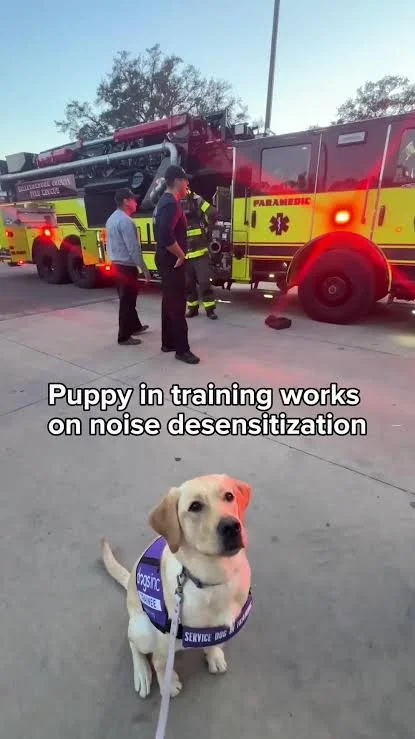
No clowns in this picture……
Thirdly, the FF crowd seem to have lost the distinction between reinforcement and reward. They are different in the behavioural scientific literature. If you are walking around with a rustling treat pouch, dishing out treats for micro-steps while the dog stares at your hip, you aren't reinforcing a chosen behaviour; you are bribing the dog to ignore the world, see picture above. A reinforcer increases a behaviour's frequency; a bribe just masks the dog's actual desire until a bigger prize comes along. The problem with that is what do you do when something does come along that is either a bigger reward or reinforcement, or both? I’ll tell you: You watch as your dog wanders off to pursue its dreams of self-determination complete with bigger prizes.
From those who have a natural inclination towards Wolves as a blueprint for dogs, and disavow the above two systems, there is a third version of clarity that comes from using pack dynamics or hierarchy as a lens to view behaviour through. With this perspective, it is claimed that a dog behaving in an unwanted manner is filling a leadership deficit or power vacuum and because the dog is ill suited to managing things in the human world, this results in anxiousness and stress building up until you get outbursts, which are sometimes violent.
It is thought that when the dog truly trusts and respects the human, they will give up control of the environment to the human and any potential problem behaviours extinguish as a result. I largely agree with this viewpoint, but that comes with one very big caveat; how the human obtains trust and respect from the dog, this is crucial. In my view, any reaching for tools negates this and puts the person squarely into the “balanced” category above. The same applies to reaching for food treats putting you into the FF category. Neither are how true trust and respect are earned.
There is another aspect of the hierarchy model that bears a closer inspection; from a strictly behavioural perspective, using a hierarchy to stop problem behaviours relies on social punishment which is experienced as negative reinforcement. If a human uses physical force, body language, spatial pressure, or vocal commands to block, stop or prevent a dog’s behaviour until the dog is sufficiently influenced, that is still forcing "submission". The human is applying environmental pressure to suppress an output. This can be very effective in the moment, and indeed over longer time periods, but because the submission was forced through a contest, it can be thought of as closer to a tyrannical relationship system and that will involve future leadership challenges and authority imposition.
Even though the intent is to project calm leadership, the dog's internal mechanism for avoiding that social pressure still falls back onto good old B.F. Skinner’s principles of avoidance learning and behavioural suppression. In English that means the dog stops or doesn’t do the “thing” to avoid your displeasure, or more accurately, just to turn off the pressure, but it does not change the dog’s desire to do the behaviour i.e. true learning about how to navigate the environment has not occurred and thus it falls short of being the ideal solution.
So what you tend to end up with using the balanced method and hierarchy method when things reach their end point is dogs that look good in almost all environments, but there is the odd occasion when things reveal that there’s a little bit of a mirage going on. The give away that all is not quite as it should be is when you see the dog having to process something unexpected or is having to make a decision and you see the dog freeze. The clue here is what the dog does or does not do. Let me set an example up.
When a dog is doing something the human doesn’t want, for this example, I shall use a dog pulling towards something it is excited about, perhaps a person they can see coming, or the entrance to a place they get to do an activity they love. When I say pull, I mean to the point that they are beginning to choke themselves or actually pull you along. I have seen this level of excitement on many occasions.
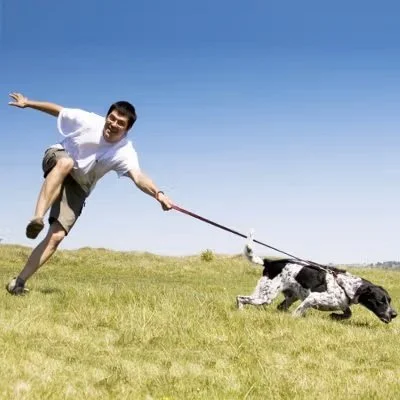
He’s enjoying that way too much
In this instance, the aversive tools used by the balanced trainers will stop a dog from pulling in this scenario. They work very well in this regard. The catch is that they only work when fitted to the dog. There is much science behind this, I’ll summarise by saying that you cannot change the desire of the dog (or human for that matter) by physical punishment. The outcome you generate is learned helplessness and often a stubborn refusal to do anything. The more stress involved in reaching this state, the more likely you will be able to see what is called a “shut down dog” i.e. a dog that is avoiding punishment at all costs by not moving but appearing very worried about it.
The FF system would have you use food treats to get the dog to pay attention to you instead of the exciting thing and then use verbal praise and physical affection as well as using the food when the dog stays still where it is. See the photo of the Labrador with fire trucks in the background earlier. This is a peculiar concept to me and is one that totally fails to understand that it is based solely on the concept of competing motivators within a transactional relationship. The moment what you have to offer is no longer a big enough bribe, you do not have a dog that will behave. There is no respect or trust of the person behind the food, because that person has never let there be. How do you get to truly know a person if every time the environment gets interesting, your interaction with them involves following food lures and a false level of praise for doing something you are totally capable of using your own brain if only you were given a chance? Do we really think the human-to-dog bond that developed over millennia was constantly primed with snacks? If you do think that, it’d be well worth your time watching how some of the mountainous aboriginal dogs are raised, that should disabuse you of any silliness you have towards the utility of the transactional relationship nonsense in the FF camp.
What the pack leader or social dynamic theorists would tell you is that you need to dominate and influence the dog so that it does not pull on that leash, as with the balanced trainers, you want the dog to know that the behaviour is unacceptable. What you might do under this system is to use your leash to pull the dog back to you and then step in front of the dog and body block it or use your body to back the dog up. You’ll need to hold the leash short so the dog cannot actually get round you, but you are essentially making the point that the behaviour will not be tolerated. You will also have to hold eye contact with the dog as this is a direct reach for authority. Here is what that looks like.
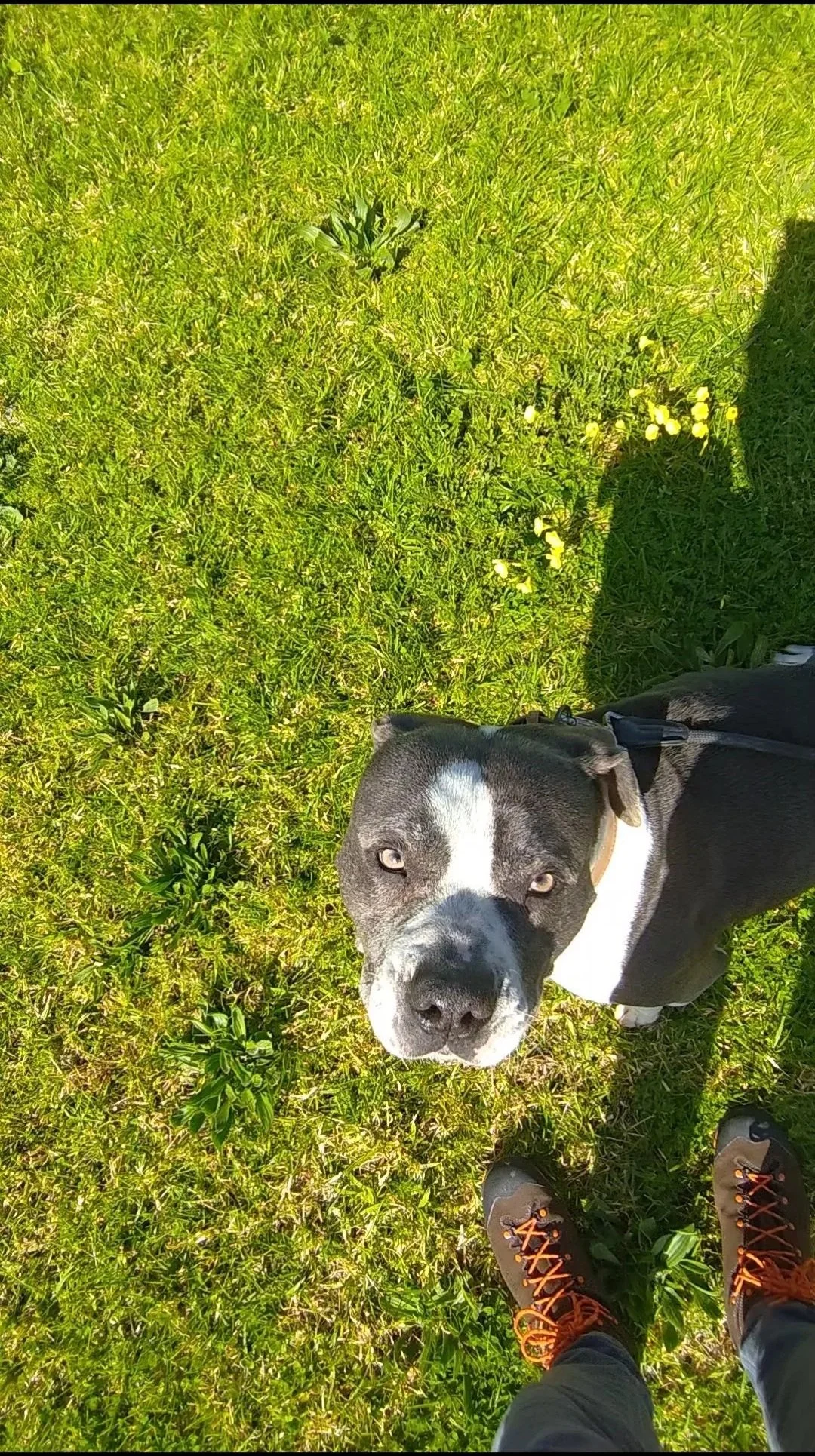
Eye contact communication
What you will see with this, as per the balanced method, is that you can bring an immediate resemblance of what looks like calm to the situation and the dog will pay attention to you because it does not want you to be annoyed with it. You could say you are now commanding the dog’s respect. I disagree. You are commanding attention, not respect. You have most certainly imposed yourself as a figure of authority in the moment, but that authority has been taken rather than offered freely and is therefore of far less value and will break under far lower levels of stress than respect offered freely. The final picture you get with the dog in this scenario is a dog that is complying because it is concerned about the consequences of not doing so. It has not actually learned to become calm within the situation and stop pulling because that will unlock what it wants, it has learned to stop pulling just so that the social and spatial pressure you placed on it releases. Very similar to the end of the balanced process.
What you are likely to see when the relationship of a pack leader theorist gets tested under stress is a dog that sometimes refuses to follow, or, makes choices a power struggle because testing of the leader is what naturally occurs when everything is constructed and acted upon through the lens of hierarchy. It’s quite easy to trap yourself here; if you think the dog is constantly ready to fill any perceived power vacuum and rule the pack, you will act out the fix to that which is to be the unequivocal leader within that dynamic, this can easily set up a vicious circle of hyper vigilance towards any perceived boundary testing. To dogs, who can read people like open books, this looks like the human is constantly on edge and therefore not a calm leader deserving of authority and respect, and thus testing the human becomes necessary, and we have our vicious circle.
So that’s a solid effort at alienating everybody who subscribes to dog training or dog raising systems that aren’t mine. So allow me to level the ship a little with some self-deprecation after a snippet of philosophy;
There’s a curious phenomenon from Tibetan philosophy that goes something like this: “the demons we fight in the external world are usually projections of our own internal fears, anxieties, and a desire for control.” Well, I for one, certainly used to hanker for control above all else. That’s not the way I approach things anymore, because it caused my dogs to distrust me. So I had better tell you about how I approach getting clarity, but first, a little more Tibetan philosophy:
Tibetan philosophy teaches that our perception of other beings is never purely objective; it is a mirror of our own mind. There is a famous Tibetan quote by Yogi Go Tsampa: “Others’ mistakes are one’s own mistakes.” What that means is you cannot perceive a specific flaw or malicious intent in someone else, or even in your dog, unless that exact seed of negativity already exists strongly within your own consciousness. So when a person constantly slanders others as "fraudulent," "a liar" or "deceitful," they are not actually describing their external world; they are describing their own internal shadow and anxieties. Western psychologists call this projection, and it’s undefeated.
In the case of the pack leader folks, if a human looks at a dog and sees only an insubordinate, calculating adversary looking for a power vacuum to fill and a crown to wear, the problem lies entirely within the human's (skewed) perception. The human is projecting their own obsession with hierarchy and ego onto the animal.
As far as a very brief overview of Tibetan philosophy on dogs that have problem behaviours goes, it approximates something like this: Our dogs are viewed as energetic extensions of the home. If a family’s dogs changed and became volatile, erratic, or aggressive, traditional Tibetans would not / do not blame the dog’s nature or assume the dog was trying to replace the pack leader with itself. They believe that the dog absorbs and reflects the chaotic energy, hidden conflicts, in their words, the corrupted lungta (wind-horse / life-force energy) of the human household. In English: The dog’s behaviour naturally absorbs and externalises the dynamic within the home of the humans. You may have heard me say before, your dog is your mirror. It’s a truism in the West and in Tibetan philosophy. To fix the dog, the humans first had to purify their own minds and intentions. This remains the case today – we must be the leader, by example.
So how do I approach the scenario I outlined above with a dog pulling towards something? There’s a reason I chose this scenario; I see it a lot, so I am familiar with it.
The way I approach this is to wait for the dog to show the behaviour I want to see, which will be a mirror of me. I will stand there calmly, holding the leash and waiting for the dog to stop being a clown. Once that has happened, we can move forward. Any return of the unwanted behaviour results in me putting on the brakes, or, in really bad cases, going backwards, and yes at that point some force is involved, and we start again. Over time the dog works out what behaviour is required to unlock what they want, because I am not telling them, I am waiting for them to work it out. Huh? Isn’t that the opposite of clarity? Yes…….but……what this does is trigger the dog’s conscious thought processes in trying to work out the problem, and once they do work it out, and they will, because they are clever, they have total clarity, and it’s a behaviour that translates nicely to pretty much every scenario in which a dog is unsure of what is required. On top of that it actually boosts a dog’s confidence because it also discovers that it is allowed to think for itself, so it starts doing that more and that is what gets you a confident independent dog that can be relied on to make the right decisions.
I was critical of the other systems earlier, so I shall apply the same to my own system. The biggest problem facing this approach is time. In our busy Western world, most of the things we need to do have a very specific time to start and finish. It is very difficult to try and work through a basic problem like a dog overexcited about an agility class when you’ve got to get on with it at a specific time, ditto a vet visit when your dog doesn’t want to go into the exam room. Our culture is unfortunately set up as the perfect antithesis to working at the dogs pace, and every time we capitulate in order to just get stuff done, we lose the learning opportunity, but worse, we reinforce the unwanted behaviour of the dog, or we breach their trust with force, making everything else more difficult because of the mixed messages the dog gets from us.
The second biggest issue I face with my method is change has to come willingly, and not all animals want to change. That is a complex function of their brain and personality and home environment. I do not force change, I cannot, it has to come organically, when it does, it is far, far stronger than all the other methods. When it doesn’t come, I cannot get to an 80 or 90 percent solution like the other methods can. It’s up to you whether the illusion of a behaved dog that breaks under pressure is better than an obviously not behaving dog.
So what it looks like when you have a half-arsed version of this approach is a dog that doesn’t listen to the human, because you are not truly respect worthy, and a dog that has also learned it can get its own way if it tries hard enough. Not a great combination to be faced with. It is what it is, only the dog in question can change its operant conditioning. All I can do is present the optimal opportunities for that change to occur, however there’s a lot of history backing me up in this being the best way of going about things.
The other facet I haven’t yet mentioned, because it really applies across the board, is breed purpose exercise. There is a point at which a dog, when chronically under-exercised enough, cannot actually get calm and behave no matter what. Think of this like trying to chain young human children to a school desk and expecting 8 hours of concentration from them with just a lunch break. It won’t work, their systems have an absolute need to get rid of energy and to grow the social side of the brain and personality, if you don’t allow for this, you very quickly end up with very badly behaved children. Well, so it is with dogs.
To conclude this slightly more acerbic than anticipated bit of writing, permit me to introduce some more of the concepts and language behind my system. Well, in all honesty, it’s not mine, it’s a blend of Tibetan philosophy and culture with James French’s Trust Technique, for which I award you no prizes for correctly guessing that his biggest influences came from the Far East. Anyway, here is a brief conceptual outline;
Bringing clarity to my dogs is a mixture of leading by example i.e. remaining calm in aroused situations, and demonstrating using my actions, that something is not scary. It is also about being a leader, but in the benevolent sense, I do not attempt to take authority from the dog. They must offer it to me freely. If I’m working with a scared dog, I want that dog to trust me when it thinks it’s in a potentially life-threatening situation. That will never happen if the dog has a part of its brain constantly worried about what I might do in response to its decisions and actions.
To head off those that think this is a soft “nice” approach, it is not. I do not let the dog walk all over me or act disrespectfully, my actions and (rarely used) words carry weight with the dogs. It’s hard to describe, but we all know people that have an obvious strength of personality. A great way to think about what that means and how to be most effective with this method is: you have to be a good person. Huh? A good person is someone who is entirely capable of doing truly bad things, physically and emotionally, but chooses not to. The person who knows how to wield their sword but chooses to keep it sheathed.
An easy simple example of this in action is when the dog and I have a disagreement over where we are going and they reach the end of the leash and pull. What I do is to face the direction I am going and wait for them to join me. I don’t speak, I don’t yank, I just indicate with my body, stay calm and wait. The longest I had to do this with a client’s dogs was 4 minutes, it’s on my YouTube channel somewhere. The key is when the dog gives up and chooses instead to follow you, you are gaining the leadership points, but it’s being offered to you. As this develops you will see the dog start to offer you behaviours as a request to go a particular direction or do a specific thing, and that is the relationship beginning to grow and you are being recognised as the leader. Eventually, this all happens without the need for a leash, and you are really heading off towards a great relationship with your dog. You can see me doing this with my dog Rollo off leash in public on my YouTube channel, and if I can do it with a Tibetan Mastiff, you can get there with your dog too.
There’s a reason I often use the word “partner” when talking about dogs. How I go about things with my dogs is a blend of leader and partner. It’s cooperative as much as it can be. I do allow my dogs to make decisions. Being the dogs they are, they need that in order to respect me. Not every dog is as independent, and so some tailoring is required, but the goal is to lead with calm, lead with trust, lead with patience, lead by example because with that, your dog will feel safe, trusted and bonded to you, and clarity will come easy.