As most of you know, or if you don’t, you can guess from my business name, that I place a lot of emphasis on overcoming behavioural problems with dogs on the relationship we have with them. This isn’t accidental or random; it’s based on both personal experience and knowledge of the history of the breed I own; the Tibetan Mastiff.
So what prompted me to write this article? The first article I wrote was about the history of the trust based relationship. It was a short article and I’ve done a lot of reading into the breed since then, so I thought it was a good opportunity to expand upon that article and my philosophy so that people can understand why I approach problems with dogs the way I do. It’s been on the cards for a while, and some recent video and comments I’ve seen on YouTube for and against the concept of the dog being Man’s best friend bumped this up the list of things to do, so I’m writing it.
Rollo and Tora are my two Tibetan Mastiffs. They are 5 years old, and are littermates. They are my first dogs. I did not grow up with dogs either, though we looked after neighbours’ dogs on the odd occasion when they went away. Suzi (Mutt) and Rufus (English Staffy) are the two I can recall.
Every single Tibetan Mastiff owner I have ever interacted with has said the same thing; these dogs are different. There is something about them that is beyond other dogs, and to live with them successfully requires us to understand a couple of key things; 1) Ownership is not a word found in the Tibetan Mastiff vocabulary. 2) These dogs will change you.
Its also worth noting that the Tibetan Mastiff is the oldest known breed in the world. DNA analysis carried out about 15 years ago showed divergence from wolves occurred 58,000 years ago. Oh and they aren’t actually Mastiff’s, that was an error of the Europeans as they discovered Tibet.
So where am I going with this? I am going to present the case for our dogs to be considered as true partners, I am going to explain where this idea comes from and how it has worked with the world’s most independent breed for tens of thousands of years.
The story of the Tibetan Mastiff is intertwined with the Tibetan people, the Tibetan Plateau is in the Himalayan mountains and sits between 10,000ft and 16,000ft above sea level and is a particularly challenging environment to survive in. It is often called “the roof of the world”. The dogs actually have a unique adaptation to cope with the altitude; their hemoglobin has a stronger binding preference with oxygen in comparison to other dogs and canids. On top of that, there are several species of apex predators that make their home in Tibet including bears, snow leopards, wolves and the Eurasian lynx. Quite the friendly bunch. These are what the (let’s call it the TM for short from here) are used to guard against.
Given the title of this article, you may not be surprised to learn that in Tibetan folklore, the TM was (probably still is) considered a demi-god. The Tibetan culture was heavily influenced by what is today Buddhism and the dogs came to be revered as guardians of sacred spaces, carriers of souls, and divine emissaries. The spots seen above the eyes (known as “eyes of darkness”) were highly prized and indicated dogs that could see clearly into the spirit realm as well as see evil. On the less pleasant end of that scale, dogs born with white tipped tails (bad luck) had them amputated.
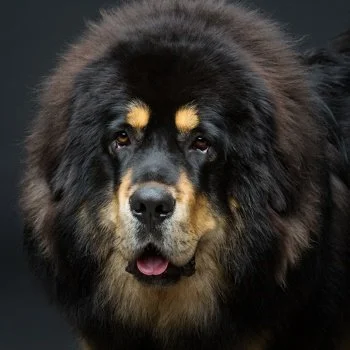
Tibetan Mastiff “Eyes of Darkness”
That’s all very interesting and I could go on forever, but really the breed history is a side issue. What I will now get into is how the Tibetan’s raised and worked these dogs in this inhospitable high altitude environment, and how the lessons they learned can be translated into our Western culture and used to great effect in overcoming problems we have with dogs in our lives today.
When I poke about TM breeders pages, magazine articles, and traditional Tibetan stories about the TM, which is where most of this article comes from, there is a very very common word that crops up: Bond. You are going to see that word and words like it crop up again and again in the following paragraphs;
To say that Tibetans "train" their Tibetan Mastiffs is to apply a Western concept to a fundamentally different relationship. In the West, dog training is a very rigid, structured, command-based process of teaching a dog to obey human instructions and to do so without question. There is little to no room for the dog to use its own brain to work out and do what needs to be done. A dog using its own smarts to determine and do a set of actions is antithetical to the Western model.
The Tibetan process is better described as shaping, guiding, or allowing the dog to become what it instinctually already is. The Tibetan method is not about breaking a dog's will or imposing human dominance through drills and repetition. If you told a Tibetan person that we “train” dogs to behave, they’d laugh at you. The Tibetan approach is all about fostering an environment of trust, respect, and clear boundaries within a family or monastic "pack" structure, allowing the dog's innate, ancient instincts to flourish.
At the end of the raising process, the Tibetan’s put the lives of themselves, their family and their stock into the dog’s hands (or paws if you prefer) and if the dog’s did not do their job, people and animals in their care died. The difference to Western thought is this trust was fully handed over, no human involvement when the dogs worked. The dogs were free to do the job as they saw fit. That is a serious level of trust.
Note: The most prized examples of the TM were often gifted to monasteries and guarded the grounds and the monks that lived there. Stories and writings of the monks provide some of the best historical info about the breed.
We shall delve into the raising process in more depth now, it’s a process passed down through countless generations of nomadic herders and Buddhist monks, the fusion of the nomadic and monastic influences have produced a raising process that is patient, mutually trusting, and a spiritually-infused (demi-gods, remember) journey that begins the moment a puppy is handed to its new family and continues throughout its life. I think that mysticism is part of the appeal to Westerners. It certainly is for me.
Puppyhood – birth to 8 months-ish
In the West, puppyhood is often focused on socialization, basic commands like "sit" and "stay," and housebreaking. The Tibetan’s in contrast, go through the first months of a TMs life dedicated to one goal: secure attachment to your family unit. Note: There are regional variations to the following descriptions, but I’m writing an article, not an exhaustive book.
A Tibetan Mastiff puppy is born into the heart of the family's life; in nomadic tents, the mother and her litter are kept inside the home, amidst the warmth of the hearth, the sounds of family conversation, the smell of yak butter tea, and the presence of children playing, entirely deliberately.
From the first days of life, the puppy is immersed in the sensory world of its first human pack (Some puppies are destined for other families or monasteries, some stay where they are born). It learns the rhythms of daily life: the sounds of the family, the clatter of cooking, the lowing of the yaks outside, the scent of the dogs who will be its future companions. There is no formal "socialization window" being tracked on a calendar. The process is more organic and constant, perhaps call it more natural, if you will.
The puppy learns to distinguish between members of its pack by scent, voice, and movement, same as all dogs do. It bonds to the specific smells of its human family, learning that these scents mean safety, warmth, and food. This is where the deep bonding begins and forms the foundation upon which all future loyalty and protectiveness will be built.
The parent dogs play the most critical role in the first fourteen weeks. They are the first and most important teachers. Through them, the puppy learns the first lesson of the guardian: discernment. Generally, the mother shows the puppies how to watch. She will sit at the tent's entrance, ears swiveled, body still, watching the horizon. The puppies, nursing and sleeping nearby, absorb this behavior as all children absorb their parents’ behaviour. The puppies begin to understand that a guardian's primary tools are its eyes and ears.
There is no command like "heel" in the traditional Tibetan Mastiff vocabulary. Instead, the first introduction to the outside world is an accompanied exploration. The puppy is not always put on a leash immediately. Instead, a family member will take the puppy outside the tent, often carrying it or allowing it to follow at its own pace. The puppy is shown the perimeter of the family's territory: the yaks, the goats, the edges of the camp. There is no pressure to interact.
If the puppy shows fear of a yak, the handler does not force it closer. They simply wait, allowing the puppy to observe from a safe distance. The handler models calm behavior. The lesson is: "These are our charges. They are part of our pack. You will get used to them in time."
Around the age of 4-5 months, the puppy is introduced to the concept of the Do-Kyi ("Tied Dog" also spelled Do-Khyi). A soft, padded tether is attached to a simple collar. The puppy is tied near the family's tent or yurt, with enough freedom to stand, turn around, and lie down comfortably. The family member stays nearby, often sitting with the puppy, speaking to it, touching it and just being present. The tether is not intended as a punishment, though technically it is; it is how the Tibetan’s begin foundation phase of learning on duty and off duty parts of the day as well as it being the introduction to the idea of a defined territory.
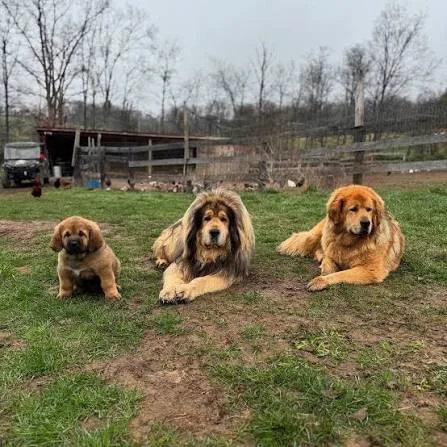
Tibetan Mastiff puppy learning the ropes
Adolescence – 8 to 18 Months-ish
Adolescence is the most critical phase in a TM’s development (This is true of all dogs). This is when the dog's natural independence, territorial instincts, and physical power begin to emerge in full force. The Western approach to this stage often involves increased obedience drills and if you go down the “balanced” route, physical corrections. The Tibetan approach is different: it involves strategic integration and controlled environmental immersion. And patience.
As the adolescent TM grows, it is gradually introduced to its various livestock charges. It is important to note here that the TM is technically a perimeter guardian, not a livestock guardian, this is the chief reason TM’s bond with their owners more strongly than with livestock; the TM stays with its humans when not working and is concerned with guarding an area, almost irrespective of what its humans put in that area. The introductions to livestock are done with extreme patience. The adolescent dog is not simply thrown into a herd of yaks. Instead, it is brought to the periphery of the flock, on a loose leash or tether, alongside an experienced adult guardian dog.
The young dog watches the adult dog's behavior. It sees how the adult dog walks the perimeter, how it ignores the grazing animals except to watch for distant movement, and how it responds to a potential threat (a bird landing, a strange sound). This is known as observational learning. The adolescent learns that the flock is part of its territory, not a toy to be chased.
This process can take months. There is no rush. “If the adolescent shows excessive interest in chasing a sheep or playing with a yak calf, the handler will issue a low, guttural correction: a sharp "Eh!" or a gentle, firm hand on the scruff, turning the dog away. This is not a punishment; it is a redirection of focus.” Well, actually, technically, this is a punishment, but it is what they do. What it does not progress to is “corrections” as you see in balanced dog training.
Somewhere in adolescence the TM begins to display its famous "aloofness" and suspicion of strangers. The Tibetan handler does not punish this, they encourage it, but with guidance; A stranger (often a friend or neighbor) will approach the camp. The adolescent TM will bark and posture. The handler does not call the dog off immediately. Instead, they stand by the dog, allowing it to bark, but keeping a hand on its collar or scruff. As the dog barks, the handler speaks in a calm tone: "I see him. I see him. Good." There is a sort of “stop” cue or command, but it’s a bit strong to call it a command;
The "stop" cue comes from the handler's overall calm authority, not from a harsh word. The handler will give a low, rolling "Ooohkay" or a soft whistle that drops in pitch. The dog learns that the handler's calm presence signals that the threat has been assessed and is under control. The fight is only to be engaged when the handler is not present or is in true danger. This only works if the person is truly calm and has the respect of the dog in terms of authority, this is why these practice activities are performed with a young dog with outcomes already predetermined by the humans. This is a really important paragraph. The human’s energy and connection with the dog are absolutely central to how the dog reacts to threats. When the human is truly trusted by the dog, just their calm presence is enough to stop the dog from guarding and getting wound up about a threat. There are no treats or toys involved, there are no distractions from the threat, just pure honest connection and relationship. Think about that in terms of the reactivity we see all over the Western world with dogs, and how people are told to fix it.
As the adolescent reaches its full size (around18 -24 months for females, 24 - 36 months for males) it is loosed from its tether at night. This is a test of supreme trust. The dog is free to roam the camp's perimeter. The family sleeps (I don’t know how through all that barking), trusting the dog to make its own judgments. This is the ultimate expression of the Tibetan philosophy: we have taught you the rules. Now you are trusted to enforce them, our lives are in your hands. There aren’t many night pictures of the TM roaming, so a day picture will have to suffice.
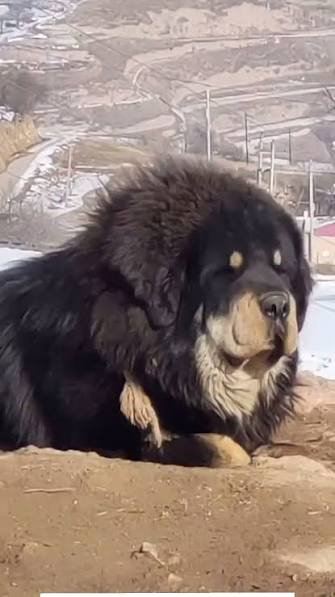
Tibetan Mastiff Resting in the Day
There is no shock collar, no electronic fence, no constant supervision. The dog is given the freedom to patrol, bark at the moon, scent the air, and decide whether the shadow in the distance is a wolf or a loose yak. This freedom is the most powerful lesson. It builds the dog's confidence, sharpens its instincts, and cements its role as a sovereign guardian. It is rare that these dogs are not part of a pack of dogs, so learning with the more experienced dogs often features at this stage.
It is a critical point to understand that Tibetans did not beat their Tibetan Mastiffs into submission à la Konrad Most. While the image of a "fierce" guard dog might suggest harsh methods, the reality is the opposite. A dog that is beaten becomes fearful and unpredictable. A fearful guardian is a dangerous guardian. A guardian that is too quick to bite or too slow to discern friend from foe is a liability.
The Tibetans have an interesting method of telling their dogs that they are unhappy with them; the handler mimics the dog's own language, using a low, guttural growl of disapproval - I cannot imagine growling at my dogs - a fixed, unblinking stare that communicates "I am the leader; you have overstepped." A direct holding of eye contact with a dog is a challenge, and it is a reach for authority, this works when and only when you are respected. If a dog is really acting out, the handler will simply leave, isolating the dog and withholding the reward of their company for a short period. For a very pack-oriented dog, this is the harshest punishment.
Adulthood – 24F / 36M Months and Beyond - I’m going to start adding in a lot more of my own thoughts from here, I’ve been sparing with those so far.
An adult TM (males are not considered mature until 3 or 4 years), properly raised in the traditional way, is a marvel of nature. It is not a robot that performs on command, and woe betide anyone that tries to go that way. It is a sentient, thinking, autonomous being that operates within a framework of deep, unspoken loyalty to its pack. There really is something different about these dogs. When they make eye contact with you and hold it, there is something deeply penetrating about it, I’m not being hyperbolic when I say it strips you down to your true honest self with nowhere to hide. There is a judgement to that gaze that goes really deep into your soul. I don’t have a picture that can do it justice.
I wanted to briefly discuss the adult Do-Kyi's day and how it is structured around its role as a sentinel, then move onto the monastery dogs.
Daytime: The dog is typically tied at the entrance to the home, monastery, or camp. This is not a time of boredom. The dog spends the day in a state of calm vigilance. It observes every person, animal, and vehicle that approaches. It lies with its head on its paws, eyes half-closed, but its ears are constantly scanning. I can confirm this is exactly how my dogs behave at home in the daytime, though they do sleep too.
Interaction with Family: During the day, family members will come and go, interacting with the dog, offering water or a scrap of food. These moments are cherished by the dog, reinforcing its bond with the pack.
Nighttime: At dusk, the tether is removed. The dog is now in full command. It will patrol the perimeter, marking the boundaries, and check on the livestock. It will lie in strategic spots, watching the skyline. Its deep, booming bark - a sound that can carry for miles - is used to announce its presence, to deter predators before they even approach. There seems to be a specific time of day that is treated as the warning to the world that their shift has started, Rollo in particular will go outside and just bark at nothing for a minute at roughly the same time of the early evening each day.
The adult Tibetan Mastiff and its human handler communicate through a subtle, silent language. A shift in the handler's posture, a slight change in breathing, a quiet word uttered under the breath - the dog reads all of this. The dog does not need a "go" command to attack. It knows when the pack is under threat because it feels the tension in the air. It knows when to stand down because it both sees and senses the handler's relaxed posture. It seems crazy, but I can vouch for this. There are times when I’ve been out with my dog daydreaming away and the moment my daydream changes to something more intense, good or bad, Rollo will stop walking and come right up to me and give me a sniff. This is him detecting my bodily signals and coming in for confirmation. It’s quite extraordinary when you start noticing this behaviour.
The pinnacle of the Tibetan approach is seen in the monastery guardians. These dogs are raised by monks who live very different lives to the nomads and villagers.
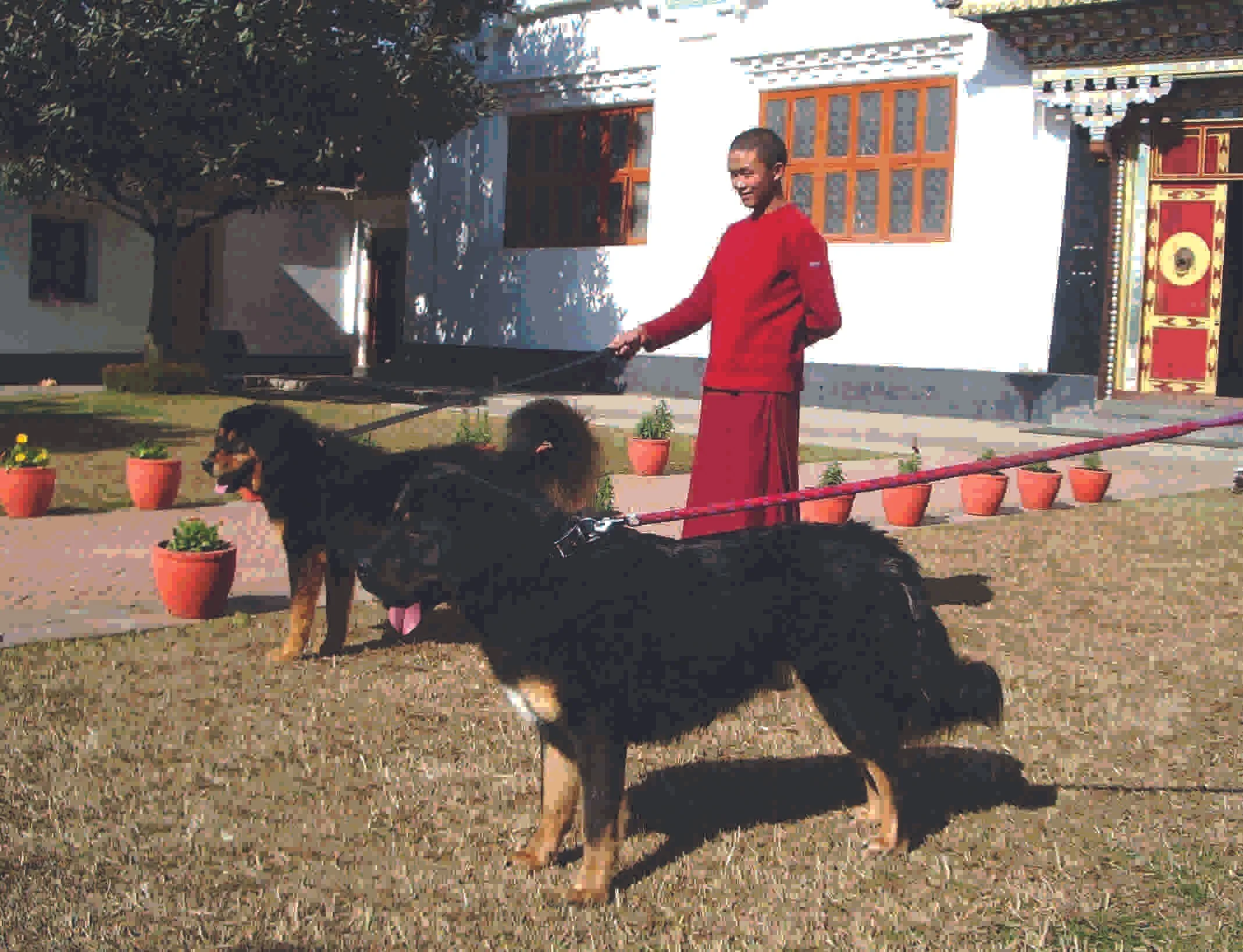
Tibetan Monks with their Tibetan Mastiffs
The puppy is raised in the sound of chanting, the smell of juniper incense, and the slow, meditative movements of the monks. The puppy is rarely scolded. It is never hit. It learns to observe, and to be still for long periods. I often say your dog is your mirror. Interesting how the dogs in the monastery behave in a similar manner to the monks isn’t it.
These dogs are famous for their absolute indifference to strangers. A visitor to a monastery might see a Tibetan Mastiff lying in the sun, eyes closed, not even acknowledging their presence. But if the visitor makes a sudden move towards a sacred object or a monk, the dog will be upright and between them in an instant, without a sound, without a growl. This is the ultimate expression of the Tibetan training: a dog so calm and so controlled that it appears almost saintly, yet is capable of explosive, decisive action when needed.
Tibetans have a word for the ideal adult Tibetan Mastiff temperament: "Log" (pronounced "loke"). It is a difficult word to translate, but it means something like "deep, abiding calm with an undercurrent of immense power."
A dog with "Log" is defined as calm but not lazy, alert but not reactive, fierce but not aggressive, loyal but not fawning, independent but not disobedient. This quality is the ultimate goal of the Tibetan method. It cannot be forced. It cannot be manufactured through drills. It is the result of a lifetime of patient, respectful guidance, built on a foundation of mutual trust, respect and love.
The Tibetan method of raising a guardian is a rebuke to the modern, fast-paced approach to dog training. It is an art form that prioritizes relationship over obedience, trust over control, and instinct over instruction. Not only that, its also stood the test of time as the most effective method to exist with dogs. There is no older example.
There is no graduation day from this training. There is no title or certificate. The training is a lifelong conversation between a people and their most trusted companions. It is a conversation conducted in silence, in the shared gaze across a windswept valley, in the warmth of a tent on a winter night, in the thunderous bark that chases the wolves away from the flock.
The result is not "a trained dog." The result is a partner, a guardian, a living legend - a Tibetan Mastiff.
So I’ll sign off by saying this: Rollo is not a trained dog. Yet you can see video of he and I out in the big wide world off leash and at dog parks having a great time, interacting with people and dogs as well as ignoring other people and dogs. This was not done by training. This was done by building a bond based on mutual trust and respect and allowing Rollo to grow into the dog he is.
Is the dog “Man’s best friend” or a demi-god? Well really that’s up to you and your own experiences, my dog is both a friend and a partner, and a being with a strange ability to strip away the noise and force me to confront who I really am just by looking at me.