Leadership; Are You Top Dog?
The best mode of being with our dogs is for the human to be the leader. This is how the most harmonious and successful relationships are established and thrive. That should not be a controversial statement to anyone.
Leadership as a concept requires words to define, but what it means to each individual person is not only clouded by personal experiences but is also something as a concept that resides firmly in the limbic brain, the part of the brain that deals in feelings, which for reasons best known only to God or evolution, does not have any capacity for language, and that’s the bit of your brain I’m trying to reach. So now you know why this subject is fraught with awkwardness.
A couple of introductory points are necessary here;
1) Wolves are not dogs. They are the forerunners of dogs. The exact species of wolf that became the domestic dog remains undiscovered by science.
2) Wolf pack dynamics are generally more cooperative and less rigid than domestic dog packs. That is a fact. This is my opinion: That does not mean that we should discount pack behaviour among wolves when considering dogs. There is a treasure trove of things we can learn from them and apply to our own lives and the lives we have with our dogs.
As you may have already deduced, this article is going to lean hard into behaviour of humans and wolves and consider how that can be applied to how we live with dogs, in terms of leadership, as the title hopefully suggested. I think the best way to make my point is to present you a story that really resonated with me. Allow me to introduce Mr Oliver Starr. This man has spent 35 years working with wild and rescued wolves in the USA.
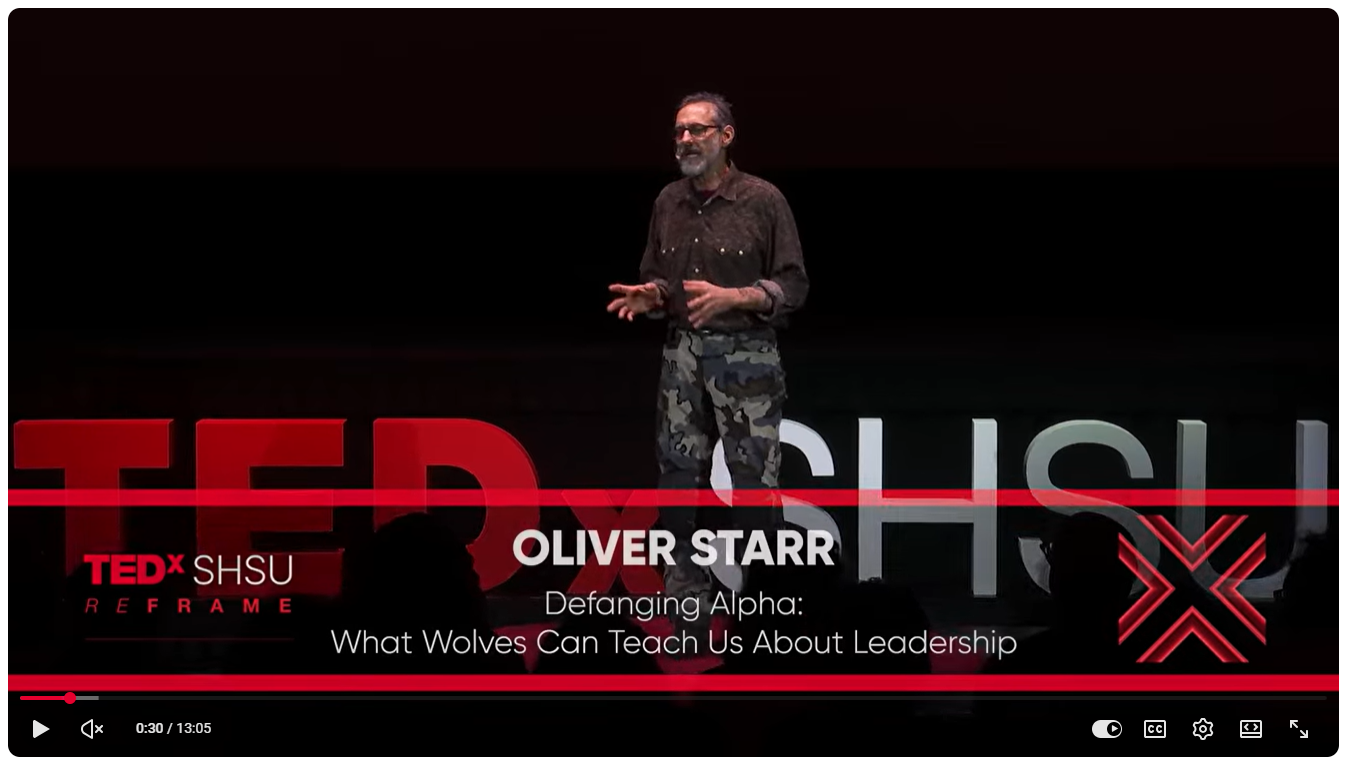
His Ted talk is here: What wolf packs can teach us about leadership | Oliver Starr | TEDxSHSU - YouTube
Much of the next several paragraphs are taken directly from his Ted Talk.
This story begins when Oliver was attacked by a wild wolf he raised himself from a pup to adulthood:
“In 1992, I was attacked by a wolf I had raised and loved. His name was Jake, a wild born wolf seized by Colorado Parks and Wildlife when they intercepted an illegal release plan. The rest of the wolves went back to British Columbia, but Jake had spent too much time close to people. He couldn't be returned to the wild, so they gave him to me. I'm Oliver Starr, the founder and executive director of the Tahoe Wolf Center, and I've spent the last 35 years living and working with wolves. Jake was my first wild wolf. We had a rare bond. He rode in the truck, walked on a leash. He even came when I called. Sometimes.
We spent thousands of hours together. I thought our trust was unbreakable until one frigid afternoon when I lost it all. But what hurt worse than the injuries was the realization that frustrated, angry, and aggressive, I'd become the wrong wolf. The truth is, I was always that guy, the stereotypical alpha, a relentless competitor obsessed with being right and winning at any cost. I believed in the saying, "Let them hate so long as they fear." I was quick to anger, slow to forgive, convinced I had to control everything.
Exactly the wrong kind of leader for wolves and people. Can you relate?
This is the story of how I failed as a leader and what wolves can teach us about getting it right. We were deep in the Colorado back country. Me, Jake, his mate Jessa, and my girlfriend Leah taking photos of the wolves for a wildlife magazine. The sun was low, the temperature dropped fast. We were tired and cold. Jake was leashed. Jessa was loose, scampering about playfully, refusing to be caught. I worried she'd run ahead to a small mountain highway. I was impatient, annoyed. Jessa thought it was a game, but I wasn't playing. As she darted past again, I pounced. Jessa squealed as I grabbed her roughly by the scruff. That's when Jake attacked.
He thought I was hurting his mate. The onslaught was so sudden and savage, I barely knew what happened. Then the pain exploded, like being struck by lightning. I left my body. Part of me fought the wolf. A life or death contest I knew I was losing. Another hovered above a drone's eye view of an epic battle. And a third, strangely narrated, calm, cool, and dispassionate. Like a scientist. He's much stronger than you expected, isn't he? Leah was screaming, "What do I do?" The scientist answered, "Grab him by the balls." She did, and Jake let go, bleeding, freezing. My arms and hands mangled. I somehow staggered the two miles back to the truck. In the ER, I remembered hearing one word. Amputation.
Your arm, the doctor said, illuminating the X-ray, is completely crushed. We don't even know which bones go where. I begged them for another way. They shot me up with morphine and sent me to another hospital hours down the road. The one place that could possibly save my arm. In shock, fading in and out of consciousness during that endless ride, one thought haunted me. My work with wolves was over. These were lifechanging, career ending injuries, save for the work of extraordinary surgeons. 37 fractures, every finger broken, a shredded bicep, more rods and pins than an engine to put things back together. But the most devastating injury wasn't physical. It was a realization that I was the wrong wolf.
I'd lost my composure, let anger lead, and destroyed a relationship that had taken years to build. I failed Jake. He never trusted me again. I failed myself. I failed as a leader. I felt ashamed and knew something had to change.
Have you ever become the wrong version of yourself, snapping when you meant to listen or pushing when you meant to lead? That was the beginning of my journey. I made a vow. No matter the stress, no matter the challenge, I would never again let anger lead. I would never again be the wrong wolf.
Since then, I've spent decades studying wolves. Not the ones in the movies or the stories from our past. I've also studied leadership, psychology, and behavioural ecology. Today, I live and work alongside a pack of ambassador wolves. I raise them. I learn from them. I stealthily sneak my groceries past their quick teeth and giant paws. Sometimes I even make it to the front door with most of my dinner.
And I lead people, too. Volunteers, conservationists, fellow executives. But now I lead the way wolves truly lead. You've heard the term “alpha wolf”. Seen the meme, listened to the podcast, perhaps felt pressured to control, dominate, and project power.
But here's the truth. The alpha wolf isn't real. The concept originated from outdated studies of captive wolves, unrelated individuals forced together. Of course, they fought. Of course, the biggest and most aggressive rose to the top. But that's not leadership. It's survival. And we see the same toxic model everywhere from boardrooms to locker rooms. It doesn't inspire. It intimidates.
In the wild, wolfpacks are families. The alphas, the real leaders are parents. They lead not through fear, but through care, not through domination, but through altruism. The kind of leadership I try to practice now with wolves, with people, with myself. Lead with calm, lead with trust, lead with patience, lead by example, but above all, lead with kindness.
Wolf biologist Gordon Habber once said, "The real leaders in wolf society lead by example and through care, not force." And Dr. Kira Cassid's work in Yellowstone confirms it. Wolf families with older calm mediators, not dominant aggressors, live longer, fight less, and thrive more. The same is true for families, for teams, for nations.
So, let me ask you, have you ever worked for an alpha? Someone who led through fear? Did it make you better or just quieter? Now, think of someone who led like a benevolent alpha. Someone who made you feel safe, trusted, inspired. That's the kind of leaders we must strive to be. My wolves and my teams follow me not because they have to, but because they trust me. They know I see them and give them space to be their best.
Have you ever been the wrong wolf? What happened when you were?”
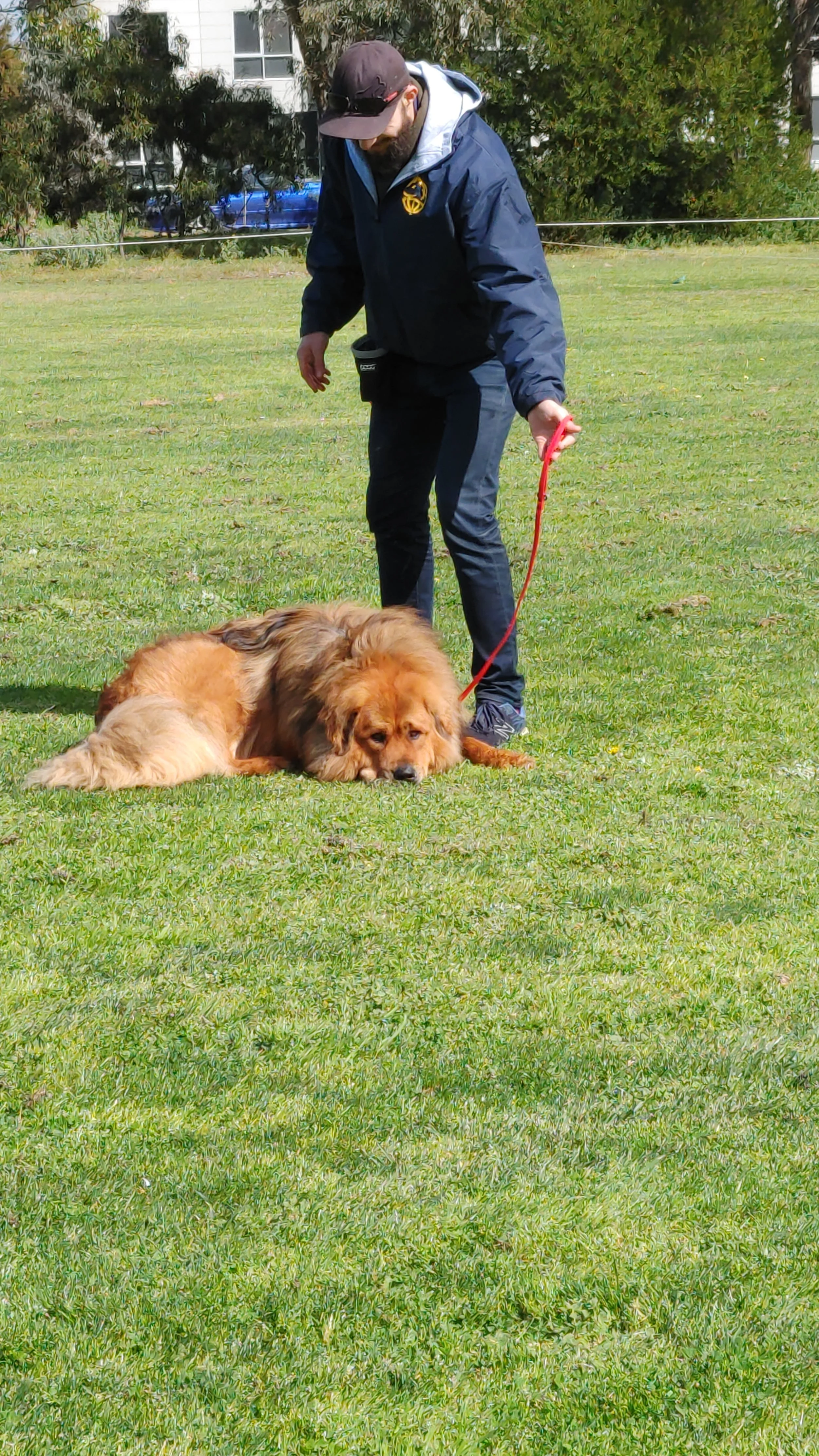
This is me being the wrong wolf. Rollo is at an obedience class assessment and should be sat up focussing on me. Rollo has told me what he thinks of this idea. Everything about this picture makes me squirm today. I have no respect for my dog, and he has none for me. I am trying to force and bribe him into doing things. This is not a relationship based on trust or respect at all and I hate what I was and i hate the system that told me this is what I needed.
I hope you found that story challenging read. I also hope you watched Oliver give his talk, words on a page don’t really do it justice.
So let me turn the lens onto myself now. When I listened to Oliver speak I felt like he could have been talking directly to me, the person I was when I got my two puppies, Rollo and Tora. I was all about being top dog, being in charge, having total control of my dogs in all situations because that is what I thought I needed. I was wrong. Very wrong.
My dog’s breeder said something to me during the process of us becoming owners of Rollo and Tora; “These guys will either make you or break you, either way, you won’t come out the other end the same person you were.” Its been one heck of a journey since then. It probably hasn’t escaped your notice that I espouse a very different message to all that time ago. My breeder was right. My dogs have changed me. Other dogs I’ve worked with have added to that, but nothing compares to my own two.
My desire for control over my dogs overrode any notion of true leadership. I wanted the idyllic picture of a single word from me and my dogs would do, or not do, whatever I said, whenever I said it. That concept appealed to me. That was a big problem, but it was a “me” problem, and the assumption that there was either something wrong with my dogs or they just needed more training, or a stronger physicality with the leash, is such a false paradigm that we are presented by society in search of performative control over a true relationship based on mutual trust and respect that it nearly ruined one of my dogs.
There was nothing wrong with my dogs, they were reflecting me back at myself. Your dog is doing the same to you. If that’s an uncomfortable thought because there are behavioural problems, good. Perhaps its uncomfortable enough for you to consider making a change or two in the direction of true leadership and partnership with your dog. So what is leadership? Well Oliver Starr has already given a pretty damn good go at explaining it and how it works in its most effective form. I’ll add to that with a view to our dogs rather than wolves.
I’ve said it before, but it bears repeating, true leadership can be defined as your ability to generate followership by your actions alone. For the avoidance of doubt, leadership is not control. That means you cannot force yourself into the position, its not a status you take from a dog. You cannot extract respect or leadership through the use of tools, aversive or otherwise, nor through physical force. Any attempts at establishing a hierarchy through anything beyond offering trust and respect will work against you in the long run. Being a leader is a state of being. A way of interacting with other sentient animals in such an authentic and open way that they willingly follow you and carry out your wishes. To add to that, as Oliver Starr said, real leaders lead with calm, lead with trust, lead with patience, and lead by example. Your dog needs your trust, needs your patience, needs your understanding and in return they will offer you a truly beautiful bond, Man’s best friend is not an understatement. When you make your dog feel safe, trusted, and inspired, they will walk to hell and back with you and for you. If that’s not where you are at right now, there’s work to be done, and it’s probably work on yourself that needs the most attention - becoming the right wolf is a journey, as is building the best relationship with your dog. In some respects, the journey is the destination.
Let me get blunt and direct a moment; if you, like I used to, think leadership is something you enforce or requires the use of tools that operate on pain to show what is not allowed, you are not leading your dog, you are controlling them. If you need to physically impose your will on your dog in order to establish hierarchy, you are not your dog’s leader, you are its jailer or tyrant. Your dog will follow you from fear of consequences and not because you are an inspiration and the best thing in your dog’s life. The true test of that is where your dog stops following you. Rollo used to have a place he wouldn’t follow me. The subway under the railway line. That is no longer the case. Tora has two places still. She used to get marched to both of these places in a slip leash and have food shoved in her face under the guise of “counterconditioning” which is actually a load of unscientific crap that is based on a very flawed “Little Peter Experiment” but my point is this seriously breached Tora’s trust in me and my wife and as a result did the opposite of having her view us as leaders.
If I could summarise what Oliver Starr said, it’d be something like this: There's a better way; in that moment when frustration, anger, or impatience tries to take the wheel, don't be the wrong wolf. Lead with calm, with trust, with kindness. Lead the way your dog and the world needs you to. Because when we stop being the wrong wolf, we stop leading the wrong way and become the kind of leaders the world needs. Go and look at your dog. Really look at them. Look into their eyes. Let them peer back into your soul. See the beautiful animal you are blessed to have in your life. That animal needs you to be their leader. The person they willingly follow, of their own free will, the person they defer to and listen to, because you are you.