What is a “Behaviour”?
This question is the epicentre of everything “dog training”. I am not exaggerating.
This question crosses boundaries between Psychology, Philosophy, Neuroscience and Religion, and yes we are going off the deep end here.
If you want the Too Long: Didn’t Read (TL:DR) summary, here it is: Behaviour has a very narrow technical definition, and dogs do not have free will when doing “behaviour”. That means dogs being subjected to physical or emotional punishment are being punished for something they cannot help doing. Aversive tools, among other things, are in this bracket. It also means reactivity and aggression are not choices, they are the result of an emotional / instinctive response. To change the behaviour, one needs to first change the feeling.
So off down the rabbit hole we go…….
Why on earth would I be reaching into something this wide ranging and complex? Ironically the answer to that is very simple: If your understanding of the answer to this question is wrong, the chances that you will be able to successfully overcome behavioural problems is very small. Oh and you won’t be able to overcome them in your dog either.
Evidently, I have made the assertion that there is a wrong answer to “What is a behaviour?” and there are many. I have witnessed many an alleged expert in dog behaviour make an absolute embarrassment of themselves in trying to define what the word means.
The two sources I have drawn on to bring about a definition of “Behaviour” are Professor’s B.F. Skinner and Jack Michael. I shall quote Skinner and Michael and then provide something in plain English.
B.F. Skinner in 1938 Behaviour of Organisms: “The movement of the organism or of its parts in a frame of reference provided by the organism itself or by various external objects or fields of force.”
Jack Michael did not define “Behaviour” in a single sentence in any papers or books that I have been able to lay my hands on. It seems Prof Michael had something of a crusade against being so reductionist and actually insisted somewhere along the way that behaviour cannot be defined without reference to the variables of which it is a function - allegedly arguing that defining behaviour is a behavioural act in and of itself, not a discovery of universal truth. I don’t think I like him anymore.
The best I can come up with is this, from Prof Michael’s “Concepts and Principles of Behaviour Analysis” first published in 1981: “Human responses are always muscle action or glandular secretion and are not appropriately referred to with stimulus terms……(he goes on to give this clarifying example) “responses to visual stimuli” would be much clearer.”
When I smash the Skinner and Michael quotes together, and translate into plain English, I derive the following working definition:
Behaviour is the body’s measurable response to a stimulus or stimuli.
A quick look at the Oxford English Dictionary provides this: “The way in which an animal or person acts in response to a particular situation or stimulus (specifically, the response of an individual or group to internal or external stimuli).”
So I could have saved myself a lot of effort by just looking at the dictionary. Well I went through all that, and you've read it, so let it stand.
Why is all that important? Because it is a necessary precursor to the question “If behaviour is a bodily response, what part of the body drives it?” The brain. Yes that is a part of the body.
For the deeper answer we turn to neuroscience. Thankfully the answer is almost cut and dry: behaviour is controlled by the limbic system in the brain. This is a subconscious part of our brain. Its where instincts and emotions are held, and curiously, the limbic system has no capacity for language. Your brain's internal communication system has to translate emotions into language, through the frontal and temporal lobes, and that's why it's difficult.
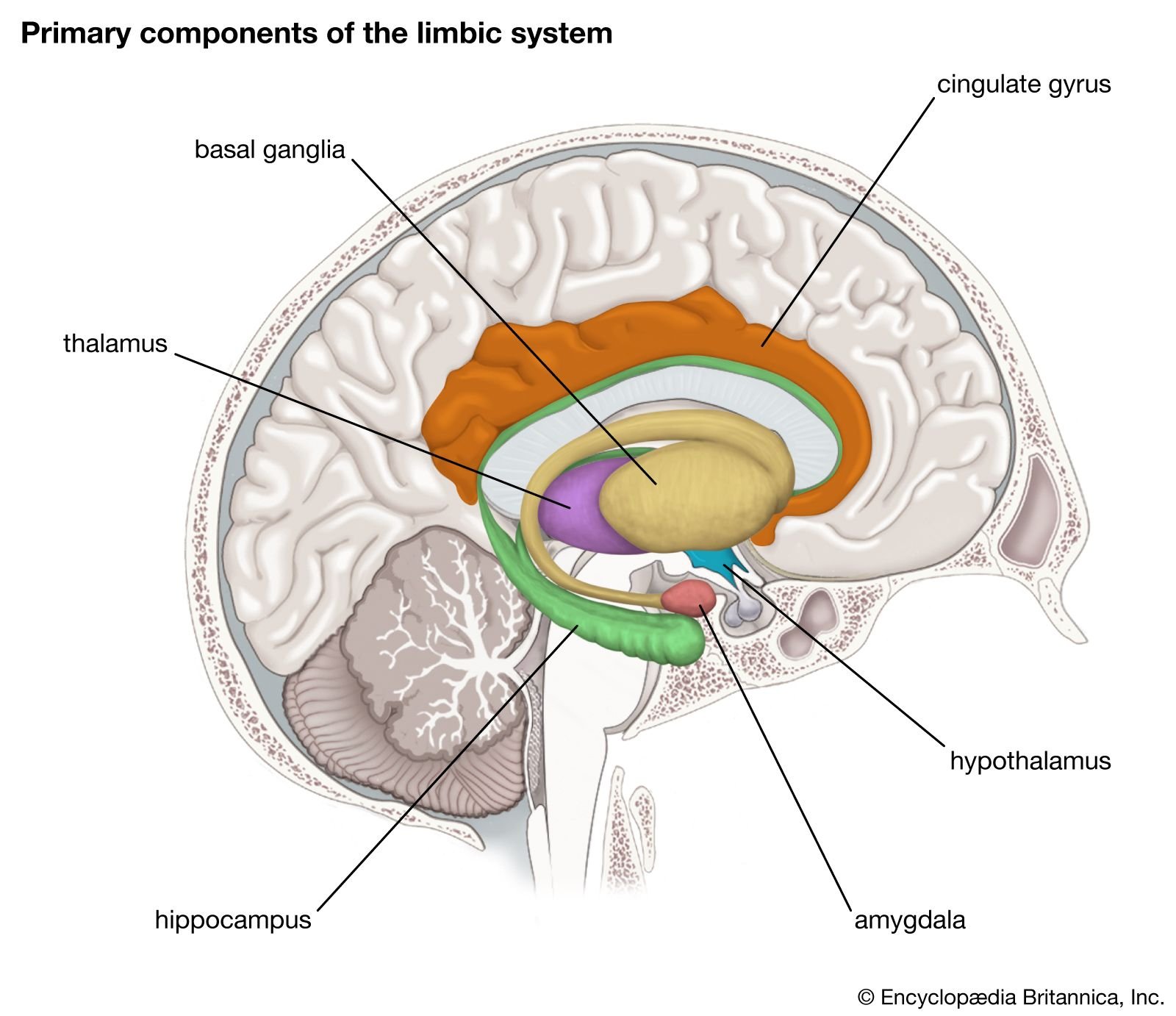
As if that wasn't enough, the real awkward bit comes when I tell you that your conscious brain has almost nothing to do with behaviour. I said almost for a reason, hold onto that for a bit.
Most of what we do in our daily life does not involve the conscious parts of our brains (90 to 95% if you want figures). We run what you might call pre-defined scripts or plays entirely subconsciously, and this works fine, that part of our brain is capable of environmental input through our 5 senses and adapting what the body is doing without needing to involve the conscious brain.
Ever caught yourself having done something 10 seconds ago but you can’t remember doing it? You were doing behaviour, entirely running on your subconscious. Not great when you have this realisation and you are driving……. you know there is a set of traffic lights just behind you, but here you are……
Dogs are the same. It’s all mammals actually. Dr G. Berns is a solid source to go and learn about that. Chase Hughes and Dr Jordan Peterson have also referenced additional sources saying the same thing in their published works. Mammalian behaviour is all controlled by the subconscious brain.
The implications of your conscious brain not being involved in behaviour are huge, we shall unpack that more, but first, let’s give some examples;
Have you ever been jump scared or seen someone jump scared? The “jump” and the associated internal dump of adrenaline are behaviour.
Have you ever touched something that burned or pricked you and you flinched? The flinch is behaviour, as is the nerve telling you “ouch”.
Have you seen someone on the phone waving their arms around wildly as they talk. Yep, behaviour.
What do we do when a very bright light shines into our eyes? Our pupils contract and we look away, often whilst trying to see and hear who is behind the light. All behaviour.
So what is the point of the conscious brain if it has almost nothing to do with behaviour? You’ll love this. Predominantly, the point of the conscious brain is to justify the actions of the subconscious. Your consciousness exists primarily to justify the things your subconscious just made you do. Isn't that fun.
Thus far, using the definition of behaviour arrived at above, which is a wholly subconscious phenomenon, the scientific community and scientific literature is united in agreement that under the technical definition, behaviour is not subject to conscious control, thus if the conscious gets involved, things get complicated, and labelling things as behaviour is no longer really fully applicable, we'll get into this in a couple of paragraphs time.
Therefore as behaviour is not conscious, it is not subject to the concept of free will. This is something that cannot be overstated in terms of it’s importance for understanding why a behaviour is happening, especially if its a behaviour we don’t want our dogs to be doing. A dog being reactive or aggressive in any given scenario is not making a choice, it is acting under instincts controlled by the limbic system of its brain. In other words, the dog cannot help having the reaction any more than you can help your reaction to being jump scared.
That is a very large and bitter pill for many people to swallow because it casts a long shadow over the things we force our dogs to do or not do. But it is a pill that must be swallowed. Remember I said earlier that the conscious has “almost” nothing to do with behaviour? Well now we need to get into that “almost” bit. We're going to have to play in sandpit of the mind, free will, conscience and what exactly is an idea or thought?
So we need to bridge all of Psychology, Philosophy, Neuroscience and Religion together to try and make some form of sense of how the conscious has an impact on behaviour. Then apply that to our dogs. Are you ready?
There is an absolutist case against the concept of free will, as in there is no such thing as free will at all. The absolutists consider free will a fallacy of the human mind. It's not a fringe idea at all, so if you think that, disabuse yourself of the notion. It is a well researched and widely published position by many leading minds in 3 of the 4 fields I mentioned above. Prof Skinner is in this category. A more recent name would be Dr Sam Harris, a neuroscientist.
As with all science there are counterpoints and contradictory evidence and opinions. So it is with free will. I decided to consult the internet and asked it to provide me 10 neuroscientists and 10 psychologists that have either published or publicly argued for the existence of free will. I won’t write all 20 names here, but suffice to say they exist, and I’m going to use their arguments here, I’ll quote names where appropriate.
The most obvious layman’s retort to being told that there is no free will goes something like this: “I just had an idea, well, four ideas, I shall use my free will to go do one of the things I just thought of." We are about to jump off the deep end. Hold tight.
Whilst the person is operating in the confines of their mind, free will applies. Possibly. Ideas are not behaviour……..well…....actually……because of the way the brain works, neurons are firing away in generating the idea before the conscious becomes aware of it, and the brain is considered part of the environment, so its responding to a stimulus, so an idea is a behaviour under the technical definition. Maybe;
As far as I’ve been able to dig up, the concept of ideas and thoughts being behaviour is and remains a fairly controversial idea, it was proposed / discovered by B. Libet and developed by JD Haynes and D. Wegner and I’m not delving into the concept any deeper here. I’ll end it by saying that the majority scientific view held is that ideas and thoughts within “the mind” are where free will sits and operates, but even this is not a unanimous scientific position, as I’ve demonstrated.
So if we are to make an argument for free will, and I will make that argument, for it to be relevant to this article / story / ravings of a lunatic / informative opinion piece, I shall have to link it back to how it can / does affect behaviour in humans, and therefore how it works for dogs too.
To nail my colours to the mast, I sit in the free will exists camp, and yes, I also sit in the camp of the conscious mind being able to influence behaviour. That is my philosophical position. It “feels” right through my non-language capable limbic subconscious, so now I’m going to use my conscious brain to interpret that feeling into language and justify the decision of my subconscious. Wait, is that behaviour, or am I exercising free will? Ha ha you’ll have to decide.
In constructing this argument, I am going to lean on Fyodor Dostoevsky, Immanuel Kant, Carl Jung, and perhaps oddly, B. Libet, and some Buddhist monks.
The neuroscientist argument for free will mostly revolves around us not understanding consciousness. We still cannot explain it in terms of matter or point to it in the brain. It seems overreaching to have decided what it is or is not capable of when we can’t even determine what or where it is.
Above this, B. Libet himself, a major proponent of absolute no free will, noted in his experiments that consciousness retains the ability to abort or veto an impulse before it results in action. He called this the “free won’t”. I like that expression.
His theory around the “free won’t” was that multiple ideas or pathways are always simultaneously firing, and the conscious can choose which of those becomes action. Think of it as your brain projecting potential actions and consequences into the future in an attempt to work out the best course of action over multiple iterations. It rapidly becomes too complex for the limbic system to choose the action pathway, so the conscious is needed. Once that's done and the body begins discernable movement, we're back into technical behaviour and our free will is off thinking about the next thing whilst the body does whatever was decided. This is often iterative as reaching the goal is never a straight line, so the conscious is called upon and influences things as needed.
The no free will absolutists argue here that the choice made by the mind under “free will” is actually nothing more than the sum of the life-long reinforcements the person has experienced, and if you were able to map someone’s life out in time order, at a high enough resolution, you could predict with 100% accuracy what their choices will be in any given scenario - this is Skinner’s position. The problem arises when you have to deal with the phenomenon of “got out of the wrong side of bed today” which is wholly contained within the body.
The person considered the most profound and in-depth literary explorer of free will is psychologist Fyodor Dostoyevsky. He is credited by both Jung and Nietzsche with being the greatest psychologist that ever lived. Interestingly he was an Orthodox Christian, but also had a few character flaws, who doesn't I suppose. I have read 4 of his 5 best works, with “Notes from the Underground” on my desk waiting to be read.
Dostoyevsky posited two main things in the arena of free will; if it could be proved that man were controlled by mathematical laws, man would choose to commit acts of irrationality just to assert freedom. In essence, if you gave man everything he needed to survive, utopia if you will, then man would rebel and break something because utopia is a mental prison that strips man of purpose and meaning. The only way to find meaningful existence, and ultimately God, is through the dangerous and authentic exercise of free will, even if that choice leads to intense personal or collective pain. To Dostoyevsky, a world without free choice is a world without morality or God, and therefore, “if there is no God, everything is permissible”. If everything is permissible, well, let your imagination run wild. It’s free to do so. Just don’t type those thoughts into an internet capable device……
A brief look at Kant gives us this: “Ought implies can.” If we are morally obligated to chose good, we must be capable of choosing it. If we are not capable, evolution has taken us off in a very weird direction, and we are nothing more than robots pretending otherwise, slaves to our environment. You might not be surprised to learn that lots of Dr's and Prof’s really think this. I think such persons arguing that you are not responsible for your behaviour might be hiding dark secrets and “no free will” = a Freudian slip of a desire for a get out of jail free card.
I’ll quickly lean on Carl Jung, a psychologist, his particular stance on free will is perhaps the most odd: free will is not something we have at birth, it is something we have to earn, and how much free will we have is proportionally related to our level of self-awareness and shadow integration. You'll have to go read him to work that one out.
Just in case you were in danger of following along, I have decided to muddy the waters some more, so let’s bring more neuroscience and then religion into the mix.
Neuroscience tells us that our brains are uniquely plastic, this means that the physical structure of the brain and functional organisation of the brain are not set, they are constantly modifiable by experience and learning and wilful action. Thus, if your choices change your neurobiology, then your choices are an independent causal force. Hang on, your choices can change your neurobiology? Yes! Neuroscience tells us that we are capable of rewiring our neural pathways.
You are not a product of your brain; your brain is a product of your history of persistent willed choices. This is the basis for the Christian belief of Sanctification; When you choose to engage in prayer, focus on a difficult task, or resist a vice, you are not just “having a thought.” You (whatever and wherever “you” are, inside your own head!!) are issuing a command to your biology to remodel itself, and it follows your orders.
If we turn to our Buddhist monk friends, I recall being taught at school that one of these monks, in protest at the Catholic South Vietnamese government in 1963, sat outside in public at a busy road intersection, poured petrol onto himself, set himself on fire and sat there aflame, silently, until he died. Everything I’ve written about the limbic system and behaviour and consciousness tells us that this should be impossible. The limbic systems’ purpose is to keep us alive and thriving and reproducing. But this is just one example of many in history that flies in the face of that scientific understanding.
So from that I conclude that we have free will, but it is more limited than most people realise, and in terms of behaviour, it is accurate to say that we don’t really have free will; the conscious brain can and does intervene at times and does make decisions on what we do. To complicate matters, it seems we (and I presume therefore dogs) are capable of rewiring neural pathways based on choices. Nothing is ever clear cut is it?
Do you remember as a child being told to count to 10 when you're angry instead of lashing out? This is actually a psychological technique designed to involve the conscious and have it intervene in your behaviour by running away and imagining the almost infinite possibilities of your potential actions, it's usually enough to make us realise the folly of what we were about to do. Now can you imagine telling children in that situation that actually there is no free will and they are not responsible for their behaviour, what of their conscience and its ability to be rewired, especially at such a key developmental period in life? That sounds to me a perfect way to unleash utter psychopaths with zero empathy or social skills. You think the Communists or Nazi's were bad……
Now the next crazy avenue we are going down is how big our conscious brain is in comparison to our subconscious.
The human brain is roughly 12.5% conscious. 87.5% is therefore devoted to subconscious functions like behaviour.
Our dogs brain is roughly 2.5% conscious. Think very carefully about that and the implications for conscious choices the dog is capable of making and how that fits with behaviour. We are barely able to use our consciousness to impact behaviour, what chance do our dogs have?
The unfortunate conclusion is that really our dogs are not making many conscious choices, and that means we really should not be punishing them for things they cannot help doing. Dogs do not have free will like we do. They do not have the most powerful conscious brain the world has ever known. Think about that next time your dog makes you want to shout at, hit, or prong collar or e-collar it. The dog is not making a choice in the way you understand it. It is reacting on instincts and emotions. Dog's sense and “feel” their environments, they don't think about or coldly calculate how to navigate them.
To change the behaviour, we must first change the feeling.
This is why I keep coming back to relationship and leadership. These are by far the more rewarding ways of being with dogs. Becoming the most effective leader you can, combined with building the strongest relationship based on mutual trust and respect that you can, is the best way of overcoming behavioural problems with our dogs.
So, erm, yeah. Behaviour and free will. My brain hurts.
True behaviour is a fully subconscious process.
We don't really have free will when it comes to behaviour, our dog's, even less so, if at all.
Free will is best associated with the mind, and an ability to intervene in behaviour with an undefined magnitude that constantly varies.
Life is demonstrably more fulfilling and engaging and rewarding when you are given the status of “Master of your own destiny”, the flip side of that coin is fully robotic slave misery with no responsibility for your own actions. Your limbic brain decided which side of the fence you are on the moment I asked you. You spent the rest of the time justifying your stance, irrespective of my words.
Wasn't that fun.